Bugatti: The Complete History — From a Family of Artists to the World's Most Extreme Hypercars
Bugatti is not just a car brand. It is a philosophy. A belief that engineering is an art form, that speed and beauty cannot be separated, and that if a car is comparable to anything else, it is not good enough.
Bugatti is not just a car brand. It is a philosophy. A belief that engineering is an art form, that speed and beauty cannot be separated, and that if a car is comparable to anything else, it is not good enough. This is the complete story of Bugatti — from a young Italian artist building his first car at age 20 to the most powerful and expensive production cars ever made.
The Man: Ettore Bugatti
Ettore Arco Isidoro Bugatti was born in Milan on September 15, 1881, into one of the most creatively gifted families in Italy. His father Carlo was a celebrated Art Nouveau designer. His brother Rembrandt became a famous sculptor. By age 20, Ettore had designed and built his first car. His guiding philosophy: “If it’s comparable, it’s not a Bugatti.”
1909: The Factory at Molsheim
In 1909, Ettore founded Automobiles Ettore Bugatti in Molsheim, Alsace. The Type 13 entered competition and finished second at the 1911 French Grand Prix.
1920s–1930s: The Golden Age of Racing
The Type 35 (1924) won over 1,000 races, including five consecutive Targa Florio victories. The Type 41 Royale (1926–1933) — only six examples built, with a 12.7-litre straight-eight engine — was designed for royalty. Today each surviving Royale is worth tens of millions.
Jean Bugatti and the Type 57 Atlantic
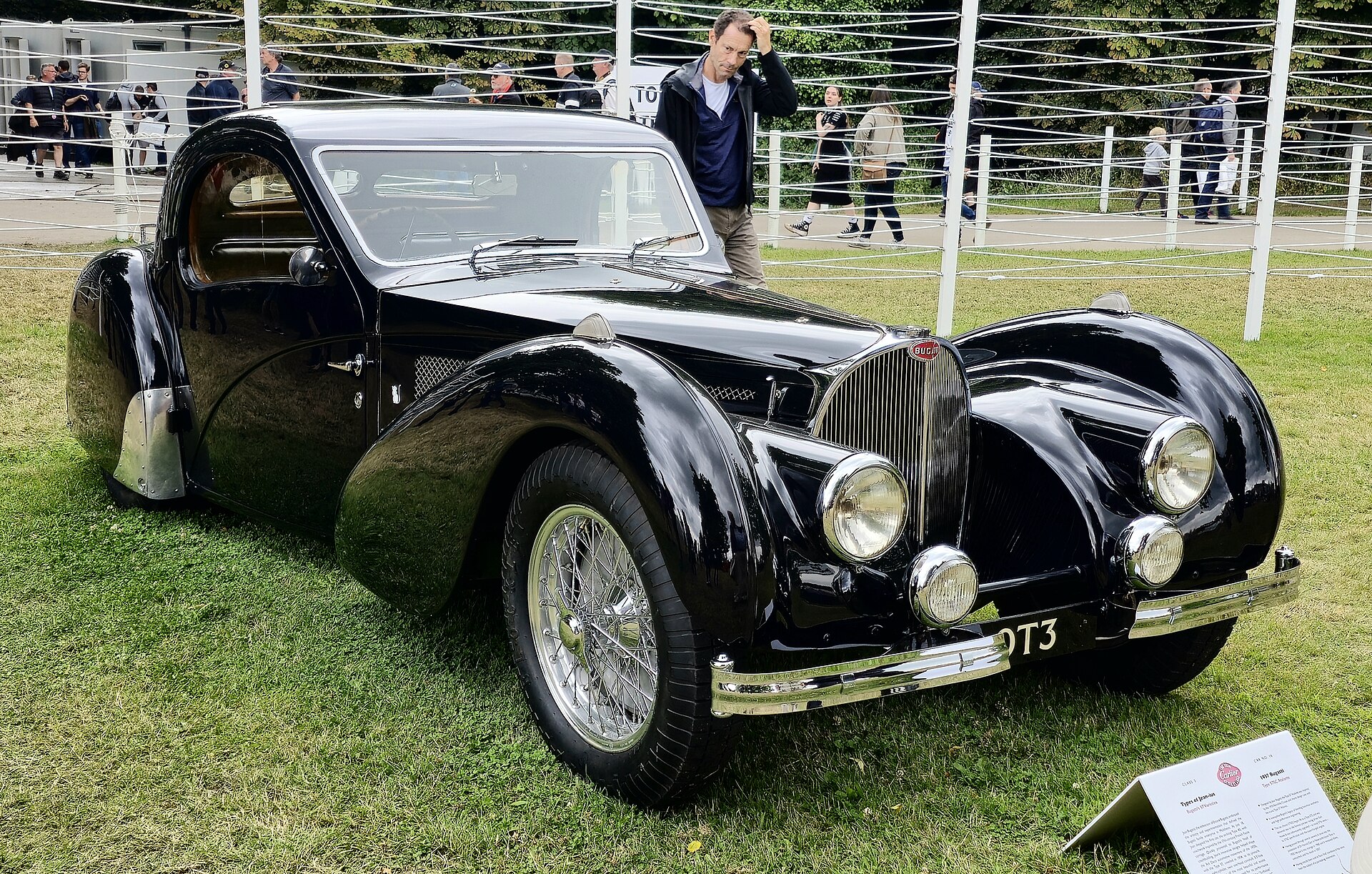
The Type 57 Atlantic (1936) by Ettore’s son Jean is considered by many the most beautiful car ever made. Four were built from electron alloy with a dramatic dorsal fin. Two surviving examples are worth an estimated $40 million each — making them among the most valuable collector cars in the world. A third — the “Lost Atlantic” — disappeared during WWII and has never been found.
Tragedy and Decline: 1939–1987
Jean Bugatti was killed testing a car in 1939, aged 30. Ettore died in 1947, aged 65. By 1963, the company was gone. For 24 years, one of the greatest names in automotive history produced nothing.
1987: The EB110
Romano Artioli resurrected Bugatti with the EB110 (1991): quad-turbo 3.5L V12, 560hp, AWD, carbon fiber chassis, 212 mph. Michael Schumacher bought one. Only 139 were built before bankruptcy in 1995.
1998: Volkswagen Saves Bugatti
Ferdinand Piëch at Volkswagen had a vision: a car with 1,001 horsepower and over 400 km/h. They created the W16 — two V8s bolted together with four turbochargers — and built a new factory in Molsheim. The same Volkswagen Group that would later save Lamborghini and fund Porsche’s expansion.
2005: The Bugatti Veyron
The Veyron 16.4 (2005): 8.0L quad-turbo W16, 1,001 PS, 0–60 in 2.5 seconds, 253 mph. Ten radiators. 450 hours of assembly per car. The engineering behind the Veyron was closer to aerospace technology than traditional automotive engineering. In 2010, the Super Sport hit 267 mph — a Guinness World Record. 450 Veyrons were built. VW reportedly lost money on every one.
2016: The Bugatti Chiron
The Chiron (2016): 1,479hp, 1,600Nm, 0–60 in 2.4 seconds. In 2019, the Chiron Super Sport 300+ became the first car to officially exceed 300 mph — reaching 304.77 mph, a record that put it at the top of the all-time top speed rankings. 500 units produced through 2024.
The Chiron era also produced two extraordinary limited editions: the Divo — 40 units focused on cornering rather than top speed — and the Centodieci, paying tribute to the EB110.
2024: The Bugatti Tourbillon
The Tourbillon (2024): naturally aspirated 8.3L V16 by Cosworth producing 1,000hp at 9,000rpm, plus three electric motors for 1,800hp total. Interior with 600+ hand-finished titanium components by master watchmakers. All 250 units sold at $4.1 million each before the reveal. It competes directly with the Koenigsegg Jesko Absolut and McLaren W1 for hypercar supremacy.
Bugatti in Numbers
| Year | Milestone |
|---|---|
| 1881 | Ettore Bugatti born in Milan |
| 1909 | Factory founded in Molsheim |
| 1924 | Type 35 — 1,000+ race victories |
| 1936 | Type 57 Atlantic |
| 1947 | Ettore Bugatti dies |
| 1991 | EB110 launched |
| 1998 | Volkswagen acquires Bugatti |
| 2005 | Veyron — 1,001hp, 253 mph |
| 2016 | Chiron — 1,479hp |
| 2019 | Chiron breaks 300 mph |
| 2024 | Tourbillon — 1,800hp V16 hybrid |
Why Bugatti Is Different
Every hypercar manufacturer claims to build the best. Bugatti is the only one that has consistently proved it — across three completely different eras, under three completely different owners. While Ferrari built its legend on racing and McLaren on engineering precision, Bugatti’s identity has always been about transcending what anyone thought was possible.
If it’s comparable, it’s not a Bugatti. One hundred and fifteen years after a young Italian artist built his factory in Alsace, nothing has changed.
Which is your favourite Bugatti — the Type 57 Atlantic, the Veyron, or the new Tourbillon? Let us know in the comments!
Explore every Bugatti on Supercars Passion: Tourbillon · Chiron Super Sport 300+ · Chiron Aerospace Engineering · Divo · Top Speed Showdown