McLaren: The Incredible Story From Formula 1 to the Road
McLaren is one of the most famous names in the world of cars and motorsport. But how did a young New Zealander with a dream create one of the greatest racing teams and supercar manufacturers on the planet? This is the story of McL…
McLaren is one of the most famous names in the world of cars and motorsport. But how did a young New Zealander with a dream create one of the greatest racing teams and supercar manufacturers on the planet? This is the story of McLaren — told simply, from the very beginning to today.
The Beginning: A Boy From New Zealand
The story of McLaren starts with one man: Bruce McLaren.
Born in Auckland, New Zealand in 1937, Bruce grew up surrounded by cars at his parents’ garage. At just 14 years old he entered his first hillclimb race. By 22 he had won a Formula 1 Grand Prix — making him the youngest Grand Prix winner in history at the time.
Bruce was not just fast. He was also brilliant at understanding how cars worked and how to make them better. He had a dream: to build his own racing cars. In 1963, he made that dream real by founding Bruce McLaren Motor Racing.
1963–1970: Building an Empire
From the very first day, McLaren was about winning.
The team built their first racing car — the M1A — in 1964. McLaren then entered the famous Can-Am Series in North America. McLaren won five consecutive Can-Am championships from 1967 to 1971 — dominating the series so completely that their orange cars became the most feared machines in motorsport.
In 1966, McLaren entered Formula 1 with their own car for the first time. Two years later, in 1968, Bruce McLaren himself took the team’s first Formula 1 victory in Belgium.
In June 1970, Bruce McLaren was killed while testing a Can-Am car at Goodwood circuit in England. He was just 32 years old. The team he built was devastated. But they did what Bruce would have wanted. They went back to the factory. They kept racing. And they kept winning.
1974–1991: World Champions, Legends, and Icons
After Bruce’s death, McLaren rebuilt — and became even more successful.
In 1974, McLaren won their first Formula 1 World Championship double with Emerson Fittipaldi. In 1976, James Hunt won the World Championship by a single point from Ferrari’s Niki Lauda.
Then came Ron Dennis. In 1980, his Project 4 Racing team merged with McLaren. Designer John Barnard introduced carbon fiber to racing for the first time with the MP4/1.
The 1980s became McLaren’s golden decade. With Niki Lauda, Alain Prost, and the legendary Ayrton Senna, McLaren dominated Formula 1. Between 1984 and 1991, McLaren won seven World Championships. In 1988 alone, Senna and Prost won 15 of the 16 races — the most dominant season in Formula 1 history.
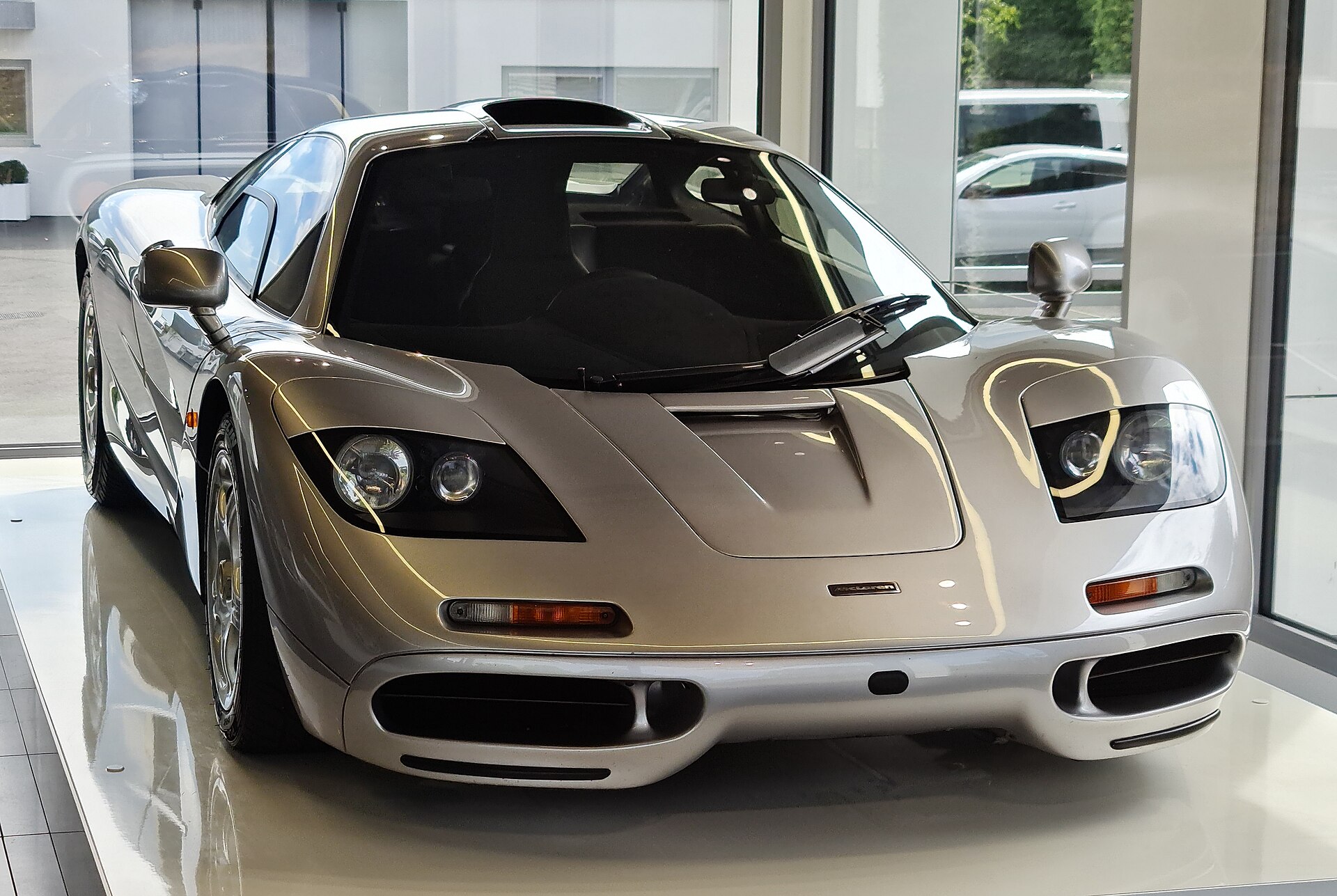
1992: The McLaren F1 — The Greatest Car Ever Made?
Designer Gordon Murray — who would later build the T.50 under his own name — had a dream: to build the greatest road car the world had ever seen.
The result was the McLaren F1, unveiled in 1992. A 6.1-litre BMW V12 engine. A central driving position. A top speed of 240 mph. A dry weight of just 1,138 kg. Carbon fiber everywhere.
Only 106 examples were ever built. Today, the McLaren F1 sells for between $15 million and $20 million at auction — making it one of the most valuable collector cars in existence.
In 1995, the F1 GTR racing version won the 24 Hours of Le Mans on its first attempt — finishing first, third, fourth, fifth and thirteenth overall.
2004: The Mercedes-Benz SLR McLaren
McLaren collaborated with Mercedes-Benz to create the SLR McLaren in 2004. A dramatic grand tourer with a supercharged V8 producing 617 horsepower and a top speed of 208 mph. It was impressive, but it was not a true McLaren. The real successor to the F1 was still to come.
2010: McLaren Automotive is Born
In 2010, McLaren launched McLaren Automotive as a dedicated road car manufacturer. The McLaren 12C arrived in 2011 — a twin-turbo V8 mid-engine supercar that immediately challenged Ferrari and Lamborghini.
2013: The McLaren P1 — Hybrid Hypercar Pioneer
The McLaren P1 was unveiled in 2013. A twin-turbo V8 combined with an electric motor produced 903 horsepower. Active aerodynamics generated up to 600 kg of downforce. Only 375 examples were built. Already the P1 has tripled in value since new.
Together with the LaFerrari and Porsche 918 Spyder, the P1 formed the legendary Hypercar Holy Trinity — three cars that proved hybrid technology could enhance, not diminish, the supercar experience.
2015–2020: A Supercar for Everyone
Sports Series — accessible supercars starting around $185,000. The 570S became one of the most praised driver’s cars of its generation, and the 600LT took its lightweight Longtail philosophy to the extreme with 592hp and 100kg stripped from the 570S.
Super Series — the core McLaren range. The 720S arrived in 2017 with 710 horsepower.
Ultimate Series — the most extreme cars. The Senna — 800hp with more downforce than a GT3 race car, named after the great Ayrton. The Speedtail — a 250mph hyper GT with a central driving seat, the spiritual successor to the F1. And the Elva — a roofless, windshieldless experience machine.
2024: The McLaren W1 — The P1’s Successor
In October 2024, McLaren unveiled the McLaren W1. 1,275 horsepower from a new twin-turbo V8 and electric motor. Rear-wheel drive only. Ground-effect aerodynamics. 2,205 pounds of downforce in Race mode. All 399 examples — priced at $2.1 million each — were sold before the car was officially revealed.
McLaren in Formula 1 Today
In 2025, Lando Norris won the Drivers’ World Championship — McLaren’s first since Lewis Hamilton in 2008 — and the team won the Constructors’ Championship for the first time since 1998. The technology transfer from F1 to road cars has never been stronger.
McLaren has now won 13 Drivers’ Championships and 10 Constructors’ Championships in Formula 1 — second only to Ferrari in the all-time rankings.
The McLaren Story in Numbers
| Year | Milestone |
|---|---|
| 1937 | Bruce McLaren born in Auckland |
| 1963 | Bruce McLaren Motor Racing founded |
| 1967 | First Can-Am championship |
| 1970 | Bruce McLaren dies at Goodwood |
| 1974 | First Formula 1 World Championship |
| 1988 | Most dominant season in F1 history |
| 1992 | McLaren F1 road car launched |
| 1995 | F1 GTR wins Le Mans |
| 2013 | McLaren P1 unveiled |
| 2024 | McLaren W1 unveiled |
| 2025 | Lando Norris wins F1 World Championship |
Why McLaren Matters
McLaren is the story of a young man from New Zealand who refused to accept limits — and built something that outlasted his own life by decades.
Every McLaren road car carries the DNA of Formula 1. Every supercar they build is designed with the same obsession for lightness, precision, and driver engagement that made their racing cars great. And every time a McLaren crosses a finish line first, it is a tribute to Bruce McLaren and the dream he never stopped chasing.
Which is your favourite McLaren of all time — the F1, the P1, or the new W1? Let us know in the comments!
Explore every McLaren on Supercars Passion: W1 · P1 · Senna · Speedtail · 600LT · Holy Trinity · F1 Tech in Hypercars