Lamborghini: The Complete History — From Tractors to the World's Most Extreme Supercars
The story of Lamborghini begins with an insult. One man, one meeting, one furious drive home — and the decision to build cars that would challenge Ferrari and shock the world.
The story of Lamborghini begins with an insult. One man, one meeting, one furious drive home — and the decision to build cars that would challenge Ferrari and shock the world. It is one of the greatest founding stories in automotive history, and it is all true.
The Man: Ferruccio Lamborghini
Ferruccio Lamborghini was born on April 28, 1916 in Renazzo, Emilia-Romagna. Obsessed with machines from childhood, he attended engineering school and served as a vehicle mechanic in WWII.
The Tractor King
In 1947, Ferruccio began converting surplus military engines into tractors. In 1948, he founded Lamborghini Trattori. By the late 1950s, the company had nearly 400 employees producing 25-30 tractors per day. He became one of the richest self-made men in Italy.
The Insult That Started a Legend
In 1958, Ferruccio’s Ferrari 250 GT had clutch problems. His mechanics found the clutch was nearly identical to his tractor’s. He drove to Maranello to tell Enzo Ferrari, who dismissed him: “Leave making cars to me. You stick to making tractors.” This legendary confrontation would define the Ferrari vs Lamborghini rivalry for the next 60 years.
Ferruccio drove home furious. By the time he arrived, the decision was made. He would build his own sports cars.
1963: The Birth of Automobili Lamborghini
In May 1963, Ferruccio founded Automobili Ferruccio Lamborghini S.p.A. in Sant’Agata Bolognese. He hired Giotto Bizzarrini (fired from Ferrari) and Gian Paolo Dallara — the same Dallara who would later found his own company and build the remarkable Dallara Stradale. The company emblem — the raging bull — came from Ferruccio’s Taurus birth sign and his love of bullfighting.
1964–1965: The 350 GT — Taking On Ferrari
The 350 GT debuted at Geneva 1964 with 280hp from a V12. Journalists were astonished by its polish. By 1966, the 400 GT 2+2 expanded the range. But the car that would truly change the world was being built in secret.
1966: The Miura — The Car That Invented the Supercar
The Lamborghini Miura placed its 4.0-litre V12 transversely in the middle — revolutionary at the time. The body by Marcello Gandini at Bertone was one of the most beautiful shapes ever. It did 0–60 in 6.7 seconds, topped 170 mph, and essentially invented the modern mid-engine supercar layout. Every supercar built today traces its layout back to the Miura. 764 units were built, now worth $1–2 million each.
1971: The Countach — The Poster Car of a Generation
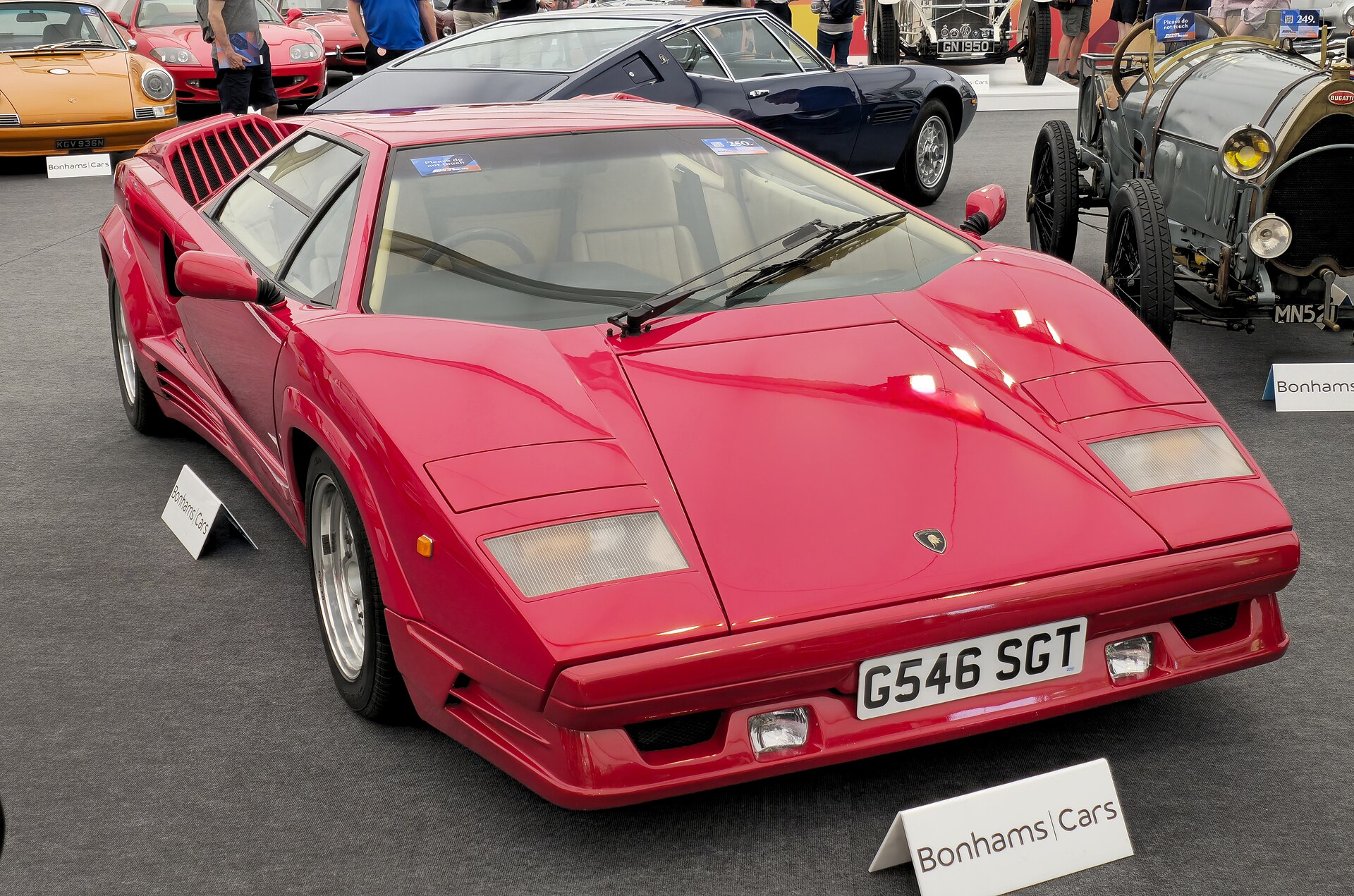
The Countach (1974–1990) had scissor doors, an impossibly wedge-shaped body, and became the single most popular car poster in history. Up to 455 horsepower and nearly 200 mph — the benchmark supercar of the 1970s and 1980s.
The Dark Years: 1974–1987
The 1973 oil crisis devastated sales. Ferruccio sold the company and retired to his vineyard. He died on February 20, 1993. The company went through bankruptcy, French ownership, then Chrysler in 1987.
1990: The Diablo — Back on Top
The Diablo (1990) became the first production car to exceed 200 mph. The VT, SV, and GT variants evolved it through the decade.
1998: The Volkswagen Group Era
Volkswagen Group purchased Lamborghini in 1998 under Audi’s control. The Murciélago (2001) re-established Lamborghini at the top. The Gallardo (2003) became the best-selling Lamborghini ever with 14,000+ units.
2011–2023: Aventador and Huracán
The Aventador (2011): 6.5L V12, 700hp, carbon monocoque. The SVJ set a Nürburgring record of 6:44 thanks to the ALA 2.0 active aerodynamics system. 11,465 units built. The Huracán (2014): 5.2L V10, with the Performante also taking a Nürburgring record.
Between the Aventador and Huracán, Lamborghini created two of the most extreme limited editions in history: the Veneno — just 9 coupés and 9 roadsters, valued at $4.5 million each — and the Sián, the first hybrid Lamborghini, powered by a supercapacitor and a 774hp V12.
2023: The Revuelto — A New Chapter
The Revuelto: the V12 combined with three electric motors for 1,001 horsepower. 0–60 in 2.5 seconds. V12 revving to 9,500 rpm. 13 driving modes. Starting at $608,000. The first production year sold out immediately. It represents the bridge between Lamborghini’s combustion heritage and its electrified future.
Lamborghini in Numbers
| Year | Milestone |
|---|---|
| 1916 | Ferruccio Lamborghini born |
| 1948 | Lamborghini Trattori founded |
| 1963 | Automobili Lamborghini founded |
| 1966 | Miura — mid-engine layout invented |
| 1971 | Countach prototype revealed |
| 1990 | Diablo — first 200 mph production car |
| 1998 | Volkswagen Group acquires Lamborghini |
| 2011 | Aventador launched |
| 2013 | Veneno — $4.5M, only 9 coupés built |
| 2019 | Sián — first hybrid Lamborghini |
| 2023 | Revuelto — 1,001 hp V12 hybrid |
Why Lamborghini Is Different
Ferrari builds cars for drivers who want to feel connected to Formula 1 tradition. McLaren builds cars for engineers who love precision. Lamborghini builds cars for people who want the world to stop and stare.
From the moment Ferruccio drove home from Maranello in 1963, furious and determined, Lamborghini has always been about proving something — that the best Italian sports car does not come from Maranello, but from Sant’Agata Bolognese.
Sixty years later, the argument is still being made. And it is still just as exciting.
Which is your favourite Lamborghini of all time — the Miura, the Countach, or the new Revuelto? Let us know in the comments!
Explore every Lamborghini on Supercars Passion: Revuelto · Sián · Veneno · Aventador SVJ · Huracán Performante · Miura · Ferrari vs Lamborghini