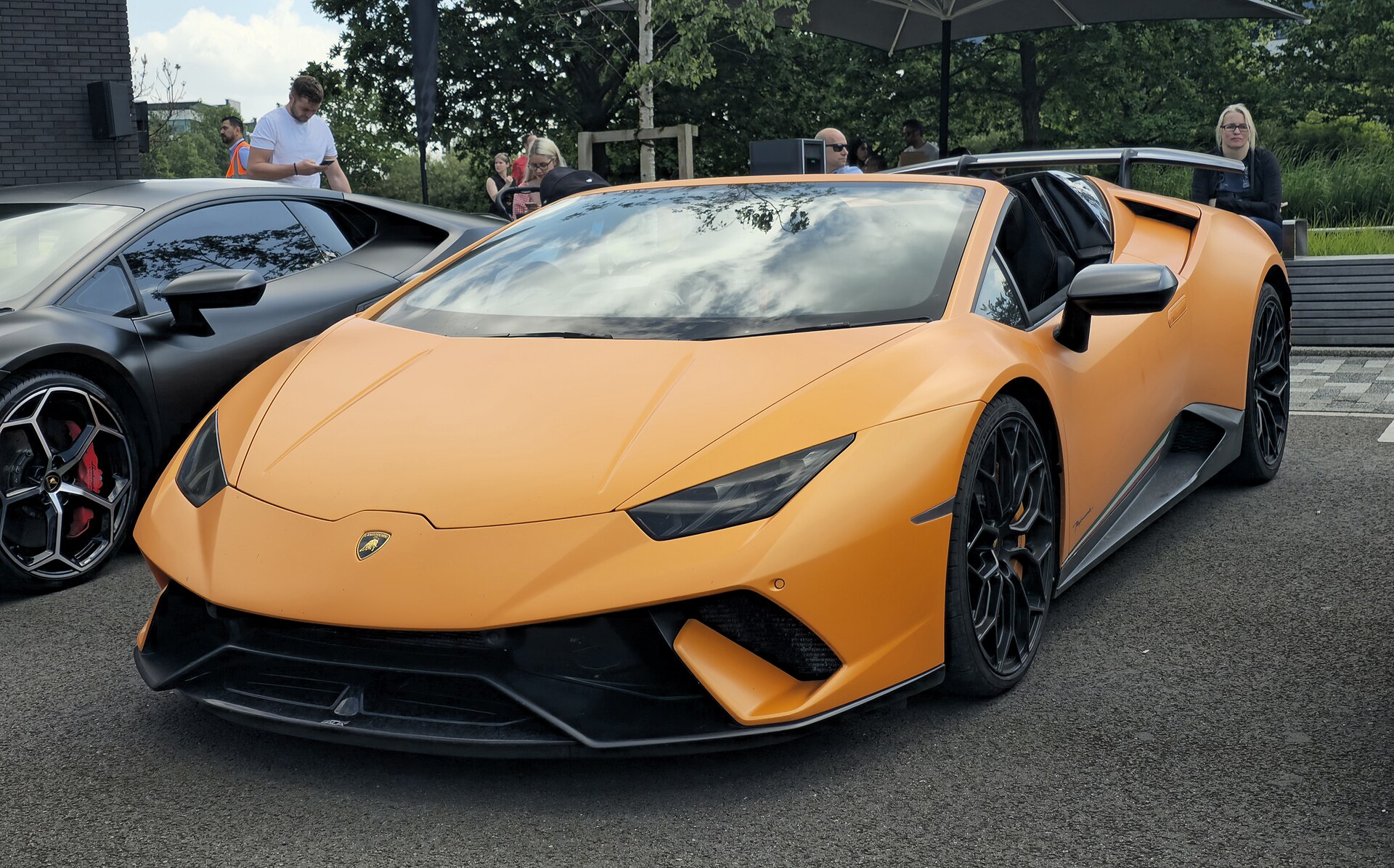
Lamborghini Huracán Performante: The Shift to Aerodynamics
Introduction — From Theater to Physics For most of its modern history, Lamborghini built cars like sculptures with engines. They were loud. They were dramatic. They were unapologetically excessive.
Introduction — From Theater to Physics
For most of its modern history, Lamborghini built cars like sculptures with engines. They were loud. They were dramatic. They were unapologetically excessive. They were designed to be seen before they were designed to be understood. The Huracán Performante is the first Lamborghini that reverses that priority. It is not designed around how it looks. It is designed around how air moves. It is the first Lamborghini where the most important component is invisible. That component is aerodynamics.
Why the Performante Exists
The Performante was not created to be a faster Huracán. It was created because Lamborghini realized something dangerous: Power alone was no longer enough. Ferrari was becoming hybrid and computational. McLaren was becoming aerodynamically obsessed. Porsche was becoming surgically precise. Lamborghini risked becoming a brand of noise in a world of intelligence. The Performante is Lamborghini’s answer.
Aerodynamics as the New Engine
The ALA system (Aerodinamica Lamborghini Attiva) is not an accessory. It is the car. ALA is a real-time airflow management network that: • Opens and closes internal air channels • Redirects airflow over or through aerodynamic surfaces • Changes downforce distribution between left and right wheels • Balances front and rear aerodynamic load dynamically This means the car does not have a single aerodynamic profile. It has hundreds. Every corner, every brake zone, every straight creates a new aerodynamic configuration. The Performante is not shaped. It is programmed.
Aerodynamic Torque Vectoring
Traditional torque vectoring redistributes power between wheels. The Performante redistributes downforce. In corners, ALA can reduce downforce on the inside wheel and increase it on the outside wheel, helping the car rotate more efficiently. This means: • Less understeer • More cornering speed • More stability at the limit The car is not just gripping the road. It is gripping physics.
Why Weight Still Matters
Even with advanced aerodynamics, weight remains the enemy. The Performante aggressively uses: • Forged composite (a Lamborghini-specific carbon fiber variant) • Carbon fiber panels • Lightweight interior components The goal is not just straight-line speed. The goal is dynamic response. Lower weight means: • Faster direction changes • Lower braking distances • More predictable behavior The Performante feels lighter than it is because it behaves lighter.
The V10 as Emotional Anchor
Lamborghini kept the naturally aspirated V10 for a reason. Turbocharging would have been easier. Hybridization would have been more fashionable. But Lamborghini understood that its emotional identity is acoustic. The V10 is not just power. It is personality. The Performante proves that intelligence does not require silence.
Nürburgring as a Philosophical Statement
When the Performante set its Nürburgring lap record, it was not a marketing stunt. It was a declaration: Lamborghini is no longer just theatrical. It is technical. It showed that spectacle and science are not opposites. They are allies.
What the Performante Represents
The Performante is Lamborghini’s transition from a brand defined by appearance to a brand defined by behavior. It is Lamborghini discovering that: • Speed is not about power • Grip is not about tires alone • Stability is not about stiffness • Performance is not mechanical — it is systemic The Performante is not a car. It is a shift.
Conclusion — The First Thinking Lamborghini
The Huracán Performante is the moment Lamborghini stopped shouting and started speaking the language of physics. It is not quieter. It is not softer. It is simply smarter. It is the first Lamborghini that doesn’t just impress you. It convinces you.
Technical Specifications — Lamborghini Huracán Performante
Lamborghini Huracán Performante: manufacturer Lamborghini; production years 2017–2019; production units approx. 640 coupés and 43 Spyders; layout mid-engine, all-wheel drive; engine 5.2-liter naturally aspirated V10 producing 640 hp at 8,000 rpm and 600 Nm of torque; 0–100 km/h in approx. 2.9 s; 0–200 km/h in approx. 8.9 s; top speed 325 km/h; transmission 7-speed dual-clutch automatic; chassis aluminum and carbon composite spaceframe with forged composite body panels; kerb weight approx. 1,382 kg; suspension double wishbone front and rear with adaptive dampers; brakes carbon-ceramic discs with 6-piston front and 4-piston rear calipers; aerodynamics ALA active aerodynamic system with dynamic front and rear aero vectoring.
Related reads: Aventador SVJ · Lamborghini Temerario · Lamborghini History