Unleashing the McLaren Speedtail: A New Era of Hyper-GT
The McLaren Speedtail isn’t a “track weapon” in the usual sense. It’s a Hyper-GT—a car designed to cover ground at shocking speed while keeping the experience refined, stable, and in a very McLaren way brutally efficient.
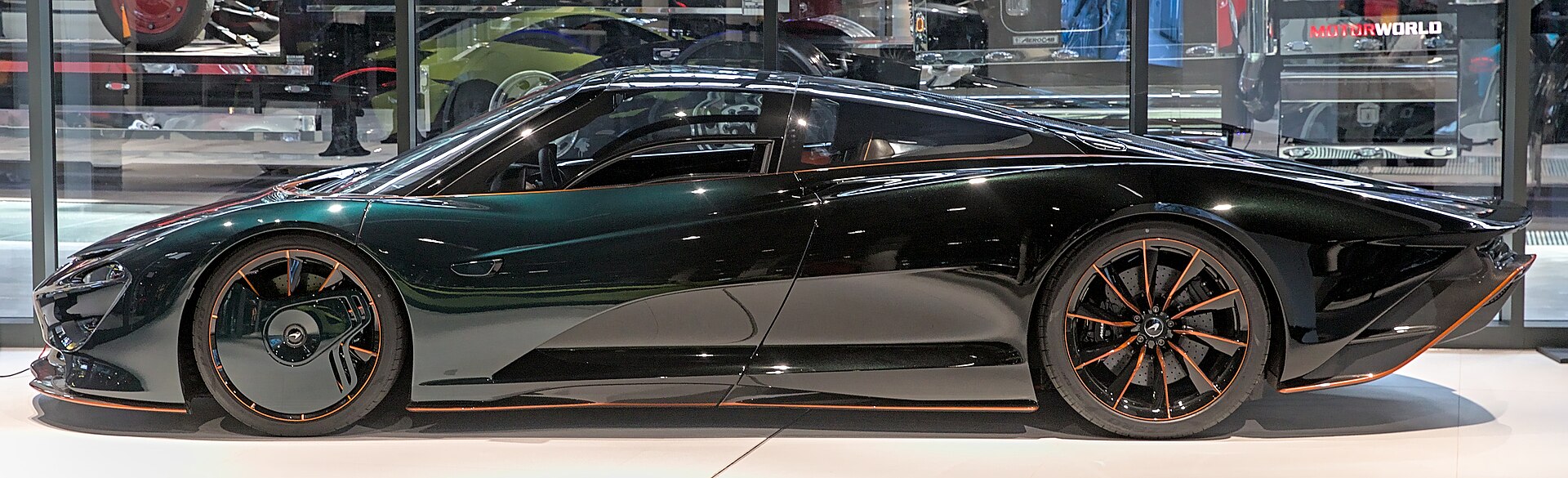
The McLaren Speedtail isn’t a “track weapon” in the usual sense. It’s a Hyper-GT—a car designed to cover ground at shocking speed while keeping the experience refined, stable, and (in a very McLaren way) brutally efficient. Think of it as the philosophical heir to the McLaren F1: not because it tries to copy it, but because it dares to ask the same question—what happens if you build a road car around ultimate speed and purity of layout?
Unveiled in late 2018 for the 2019 model-year spotlight, the Speedtail became McLaren’s statement piece: a long-tail shape, a hybrid powertrain, a central driving position, and a 250 mph target—all wrapped into one of the most aerodynamic road cars McLaren has ever made.
The concept: “Hyper-GT” done the McLaren way
Most hypercars scream “lap time.” The Speedtail whispers something more dangerous: effortless velocity. Its design is dominated by aerodynamic intent—smooth surfaces, an elongated rear, and details aimed at reducing drag rather than generating brute downforce.
This is why the car feels almost spaceship-like in photos: the proportions aren’t styling. They’re physics.
Central driving position: the F1-inspired cockpit layout
One of the Speedtail’s most iconic features is the three-seat cabin with the driver in the center, flanked by two passenger seats slightly behind—an unmistakable nod to the McLaren F1 formula.
It’s not just cool trivia. A central seat gives:
- Perfect symmetry and consistent sightlines
- A special sense of “command” over the car
- An experience that feels unlike any conventional supercar
Powertrain: twin-turbo V8 + e-motor, tuned for relentless speed
The Speedtail uses a twin-turbocharged 4.0L V8 paired with an electric motor (parallel hybrid system).
McLaren’s official figures put it firmly in “how is this road legal?” territory:
- Max power: 1070 PS (1036 bhp)
- Max torque: 1150 Nm (at 5,500–6,500 rpm)
- Drivetrain/layout: rear mid-engine, rear-wheel drive (parallel hybrid)
This isn’t hybrid for eco points—it’s hybrid for sustained thrust and high-speed performance.
Performance: 250 mph, and the acceleration to match
McLaren’s headline numbers are properly outrageous:
- Top speed: 403 km/h (250 mph)
- 0–100 km/h (0–62 mph): 3.0 s
- 0–200 km/h (0–124 mph): 6.6 s
- 0–300 km/h (0–186 mph): 12.8 s
In other words: it doesn’t just reach 250 mph—it’s engineered to make the run feel stable and repeatable.
Weight, size, and the “long-tail” proportions
The Speedtail is visibly longer than most modern McLarens, and the official specs confirm it’s built around that stretched, low-drag silhouette.
- Dry weight (lightest): 1,499 kg
- DIN kerb weight: 1,597 kg
- Length: 5,137 mm
That combination—length + aero + hybrid power—explains why the Speedtail sits in its own niche: it’s less “attack the apex,” more “delete continents.”
Rarity and collectability
McLaren limited the Speedtail to 106 cars—a number chosen as a deliberate historical wink to the McLaren F1’s production scale.
It also sits inside McLaren’s Ultimate Series, alongside cars like the McLaren P1 and McLaren Senna.
If you’re the kind of enthusiast who values “engineering as art,” the Speedtail is already one of those future-timeline icons.
Quick spec sheet (official highlights)
- Model: McLaren Speedtail (2019 model-year reveal cycle)
- Powertrain: 4.0L twin-turbo V8 + eMotor (parallel hybrid)
- Max power: 1070 PS / 1036 bhp
- Max torque: 1150 Nm
- Top speed: 403 km/h (250 mph)
- 0–300 km/h: 12.8 s
- Seats: 3 (central driver position)
- Production: 106 units
Final take
The Speedtail is what happens when you stop building a hypercar around lap times and start building it around high-speed efficiency and aero intelligence—without losing the drama. It’s rare, technically fascinating, and conceptually bold enough that nobody else has really copied it.
If you could own one Hyper-GT, would you pick the Speedtail—or something more track-focused? Comment below with your choice and your reason (I read and reply). And if you want more deep dives like this—specs, engineering breakdowns, and “why it matters” stories—subscribe to SupercarsPassion and share this article with one car friend who’d get it.
Related reads: How LaFerrari, P1 & 918 Spyder Revolutionized… · Top 3 Daily-Drivable Supercars · McLaren W1