Bugatti Chiron: The Aerospace Car Redefined
Introduction: When a Car Stops Being a Car The Bugatti Chiron is often described as a “car,” but this label is deeply misleading. In reality, the Chiron is far closer to an aerospace system than to a traditional automobile.
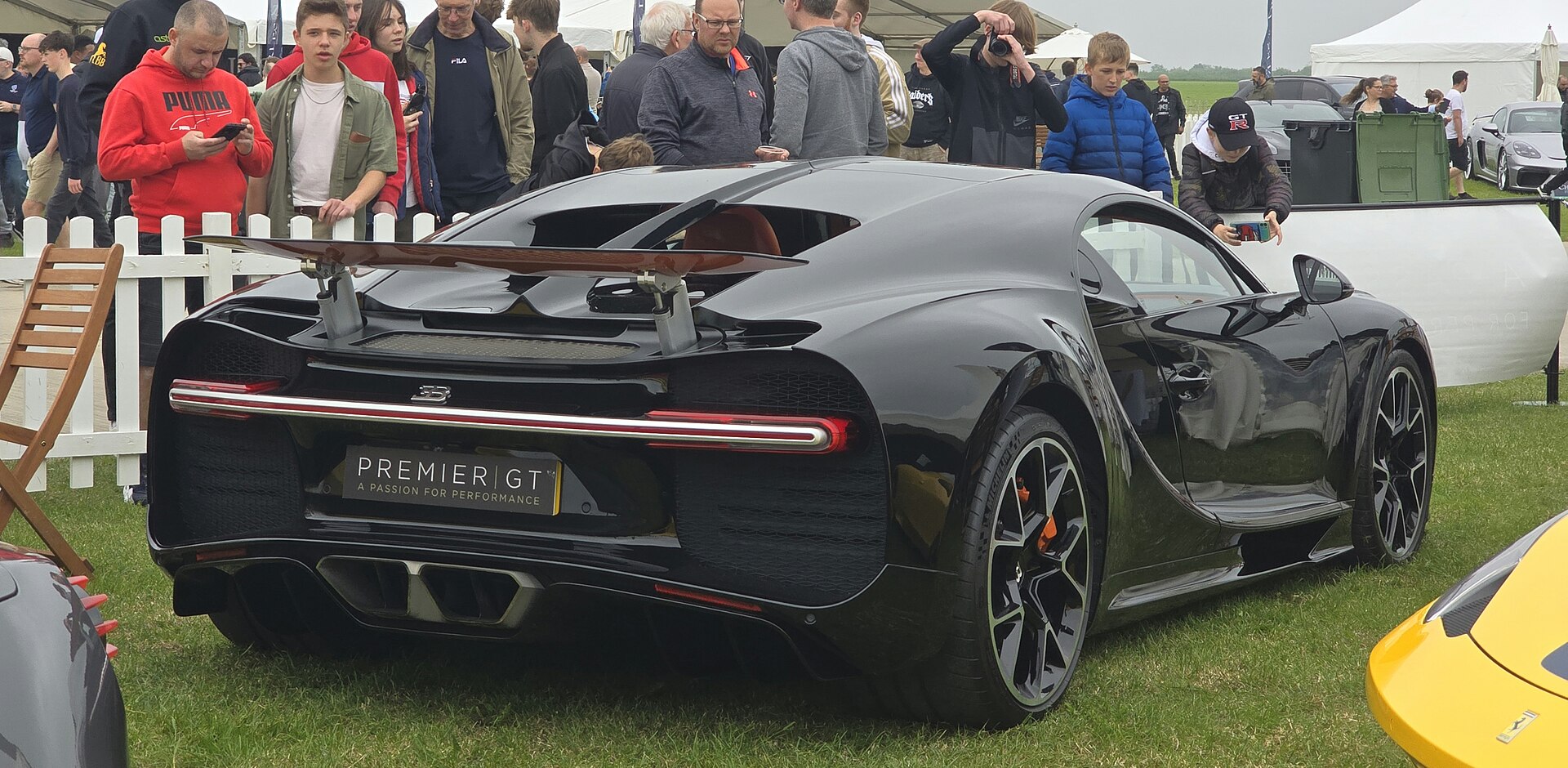
Introduction: When a Car Stops Being a Car
The Bugatti Chiron is often described as a “car,” but this label is deeply misleading.
In reality, the Chiron is far closer to an aerospace system than to a traditional automobile.
Its design philosophy, engineering constraints, material science, thermal management, and safety systems resemble those of a jet aircraft or a spacecraft more than those of a road vehicle. The Chiron is not built primarily to transport humans — it is built to control extreme energy, extreme forces, and extreme instability within a narrow envelope of survivability.
In other words: the Bugatti Chiron is an aerospace machine that happens to have four wheels.
Let’s explore why.
1. The Power Density Problem
At the heart of the Chiron sits an 8.0-liter quad-turbocharged W16 engine producing:
- 1,500 horsepower (standard)
- 1,600 horsepower (Super Sport)
- Over 1,180 lb-ft (1,600 Nm) of torque
This is not just “a lot of power.”
It is an extreme power-to-volume and power-to-mass problem — exactly the same type of problem aerospace engineers face when designing jet engines.
Aerospace parallel:
Jet engines must deliver maximum thrust from minimal mass and volume while operating under intense thermal and mechanical stress. The Chiron’s engine operates under:
- Combustion chamber pressures exceeding those of most racing engines
- Continuous full-load operation for sustained high-speed runs
- Thermal loads that would destroy conventional automotive cooling systems
The challenge is not creating power. The challenge is containing power without self-destruction.
2. Thermal Management: The Real Engineering Nightmare
If you ask Bugatti engineers what the hardest problem is, the answer is not power — it is heat. At full load, the Chiron generates enough heat to:
- Melt aluminum components
- Destroy lubricants
- Cause structural deformation
The cooling system includes:
- 10 separate radiators
- Over 60 liters of coolant
- A network of heat exchangers more complex than those used in many small aircraft
Aerospace parallel:
Thermal regulation in aerospace is mission-critical. Spacecraft, jets, and hypersonic vehicles fail not from lack of thrust but from heat accumulation. The Chiron’s cooling architecture resembles that of a jet engine nacelle more than that of a car.
3. Aerodynamics: Managing Stability at 400+ km/h
At 420 km/h, aerodynamic forces dominate everything. Downforce, lift, drag, and pressure distribution become life-critical variables. The Chiron actively modifies its aerodynamic profile using:
- An adaptive rear wing with multiple attack angles
- Active ride height adjustment
- Variable cooling duct openings
Aerospace parallel:
Aircraft constantly change control surfaces to maintain stability across different flight regimes. The Chiron does the same across different speed regimes.
At low speed it behaves like a luxury car.
At high speed it behaves like a guided missile with a passenger cabin.
4. Structural Engineering: A Carbon Fiber Pressure Vessel
The Chiron’s carbon monocoque is designed to:
- Resist enormous torsional loads
- Absorb crash energy at extreme velocities
- Maintain cabin integrity under forces exceeding 2–3 G continuously
The passenger cell functions more like a pressure vessel than a car body.
Aerospace parallel:
Aircraft fuselages and spacecraft hulls are built as stress-optimized shells, not frames with panels attached. The Chiron follows the same philosophy.
5. Materials Science: Aerospace-Grade Components
The Chiron uses:
- Titanium fasteners
- Carbon fiber composite structures
- Ceramic braking systems
- High-temperature alloys similar to those used in turbine engines
These materials are expensive, difficult to manufacture, and unnecessary for normal cars — but essential when operating at the physical limits of road legality.
6. Systems Integration: The Real Masterpiece
What truly makes the Chiron an aerospace machine is not any single component — it is the integration of all systems:
- Powertrain
- Cooling
- Aerodynamics
- Structure
- Electronics
- Safety
All must operate perfectly together. Failure in one system leads to catastrophic failure. This level of integration is far closer to spacecraft design than to automotive assembly.
7. Why This Matters
The Bugatti Chiron represents a turning point. It marks the moment when:
- Automotive engineering reached the edge of physics
- Further progress required aerospace methodologies
- Cars stopped being mechanical objects and became cyber-physical systems
Future hypercars will move even further in this direction — integrating AI, simulation, digital twins, and advanced materials. The Chiron is not the end of automotive engineering. It is the beginning of something else.
Conclusion: The Chiron Is Not a Car — It Is a Machine of Power Control
A car is designed to move people. The Bugatti Chiron is designed to control violence — the violence of heat, pressure, speed, and force — within a thin shell of carbon fiber and software. That is not automotive engineering. That is aerospace engineering, adapted for the road. And that is why the Bugatti Chiron is one of the most extraordinary machines ever built.
Bugatti Chiron Family — Technical Specifications (Standard, Super Sport, Pur Sport, Mistral)
Bugatti Chiron family: manufacturer Bugatti Automobiles; production years 2016–2024 (depending on variant); total production 500 units across all variants; layout mid-engine, all-wheel drive; engine for all variants: 8.0-liter quad-turbocharged W16; Chiron Standard: power output 1,500 hp at 6,700 rpm, torque 1,600 Nm from 2,000 to 6,000 rpm, 0–100 km/h in 2.4 s, 0–200 km/h in 6.1 s, 0–300 km/h in 13.1 s, top speed electronically limited to 420 km/h, kerb weight approx. 1,995 kg; Chiron Super Sport: power output 1,600 hp, torque 1,600 Nm, 0–100 km/h in approx. 2.4 s, 0–200 km/h in 5.8 s, 0–300 km/h in 12.1 s, top speed 440 km/h limited (490+ km/h prototype), kerb weight approx. 1,975 kg, optimized long-tail aerodynamics for low drag; Chiron Pur Sport: power output 1,500 hp, torque 1,600 Nm, shorter gear ratios, 0–100 km/h in approx. 2.3 s, top speed limited to 350 km/h for gearing and downforce optimization, increased downforce and stiffer suspension, kerb weight approx. 1,945 kg; Chiron Mistral: power output 1,600 hp, torque 1,600 Nm, roadster body with no roof, 0–100 km/h in approx. 2.4 s, top speed over 420 km/h (record-setting open-top speed above 450 km/h), kerb weight approx. 2,000 kg; transmission for all variants: 7-speed dual-clutch automatic; chassis: carbon fiber monocoque with carbon composite body panels; suspension: double wishbone front and rear with adaptive dampers; brakes: carbon-ceramic discs with 8-piston front and 6-piston rear calipers; aerodynamics: fully active system with adaptive rear wing, variable ride height and cooling management, with higher downforce on Pur Sport and lower drag optimization on Super Sport.
Related reads: Bugatti History · Chiron Super Sport 300+ vs Venom F5 vs Tuatara · Bugatti Tourbillon