Bugatti Tourbillon: The 1,800 HP Hypercar That Redefines Everything
The Bugatti Tourbillon is not just a new car. It is a new era. With 1,800 horsepower, a naturally aspirated V16 engine developed with Cosworth, three electric motors, and a price tag of $4 million, the Tourbillon is the most extra…
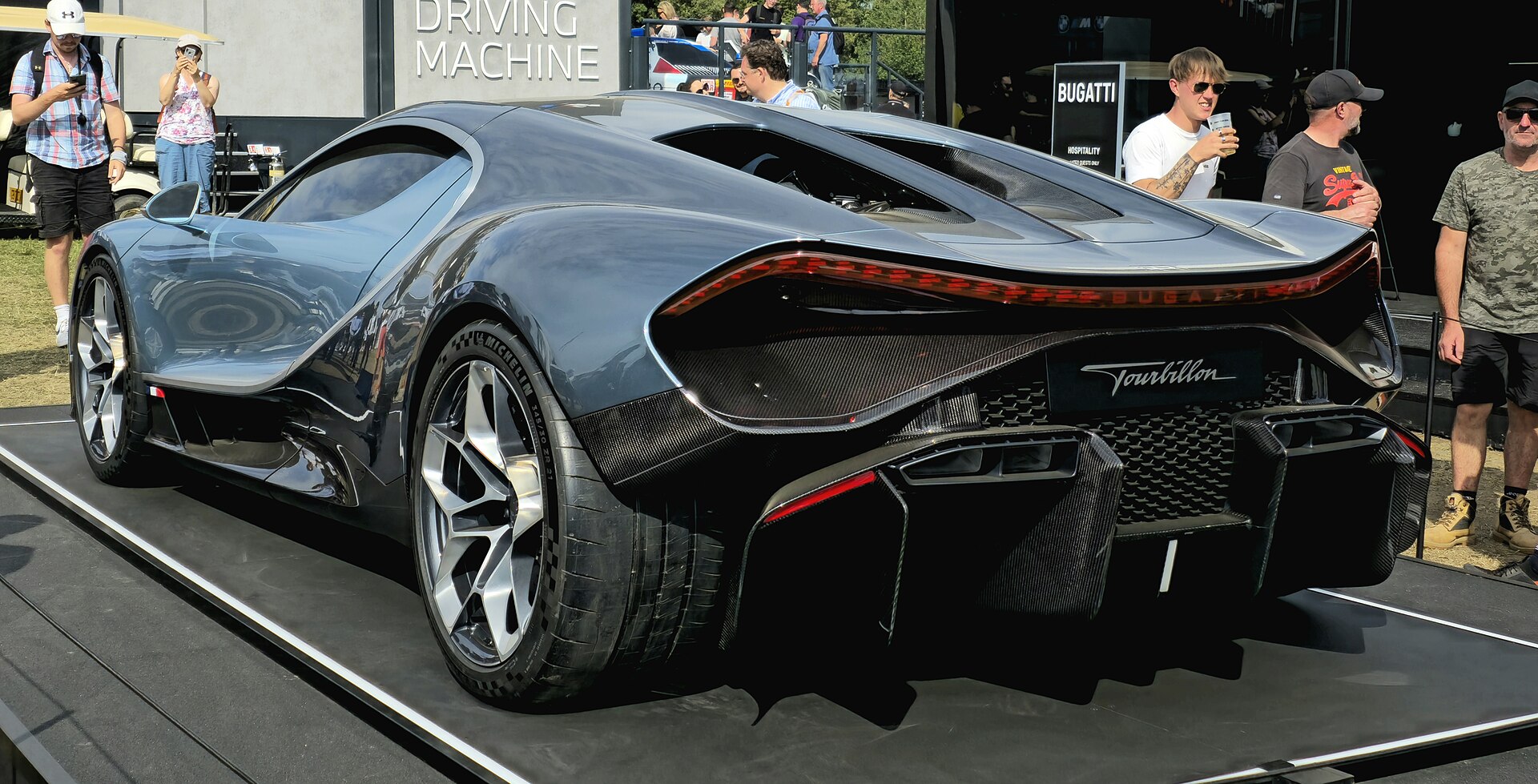
The Bugatti Tourbillon is not just a new car. It is a new era. With 1,800 horsepower, a naturally aspirated V16 engine developed with Cosworth, three electric motors, and a price tag of $4 million, the Tourbillon is the most extraordinary road car Bugatti has ever created — and arguably the most extraordinary road car ever built.
The End of the W16. The Beginning of the V16.
For over two decades, Bugatti’s identity was inseparable from one engine: the legendary quad-turbocharged W16. It powered the Veyron to 253 mph. It powered the Chiron to 304 mph. It defined what a Bugatti was.
The Tourbillon changes everything. Unveiled in June 2024 as the direct successor to the Chiron, it replaces the W16 with an entirely new 8.3-litre naturally aspirated V16, developed with Cosworth. No turbochargers. No superchargers. Just sixteen cylinders, 8,355cc, and a 9,000 rpm redline.
On its own, the V16 produces 1,000 horsepower — roughly matching the output of the entire Veyron. But the Tourbillon is not finished there.
1,800 Horsepower: The Most Powerful Production Car Ever
Three electric motors complete the powertrain. Two on the front axle, one at the rear, working through an eight-speed dual-clutch gearbox. Combined total: 1,800 horsepower. A 25 kWh battery provides ~37 miles of pure electric range.
| Specification | Detail |
|---|---|
| Engine | 8.3L NA V16 (Cosworth) + 3 Electric Motors |
| Total Power | 1,800 hp |
| V16 Power | 1,000 hp at 9,000 rpm |
| 0–62 mph | 2.0 seconds |
| Top Speed | 276 mph (445 km/h) |
| Electric Range | ~37 miles |
| Production | 250 units (sold out) |
| Price | €3.8M (~$4.1M) |
Engineering Masterpiece: Chassis, Suspension and Materials
The chassis uses T800 carbon composite — aerospace-grade material. The 25 kWh battery is integrated as a structural element of the monocoque. Bugatti collaborated with Divergent Technologies to create AI-designed, 3D-printed suspension components that are 45 percent lighter than the Chiron’s.
Despite carrying a full hybrid system, the Tourbillon is lighter than the Chiron it replaces.
Design: Evolution With Purpose
Inspired by the peregrine falcon, the Tourbillon’s profile achieves its 276 mph top speed without a raised rear wing. Self-opening dihedral doors, slimline LED headlights reimagining Bugatti’s “eight-eye” design, and the Équipe Pur Sang variant with eight exhaust outlets.
The Interior: A Watchmaker’s Workshop at 276 MPH
The instrument cluster was built by Swiss watchmakers: over 600 titanium components operating through mechanical gears, not digital displays. The center console is machined from solid aluminum and encased in crystal glass. Seats fixed to the floor, steering wheel and pedals adjustable — exactly as in Formula 1.
Bugatti Tourbillon vs. The Competition
At $4 million and 1,800hp, the Tourbillon occupies a category essentially alone. The Ferrari F80 (1,200hp, ~$3.5M) is the closest in price but offers 600hp less. The Lamborghini Revuelto ($608K, 1,001hp) is in a different financial galaxy. The McLaren W1 (1,275hp, ~$2.1M) combines F1 tech with raw power. And the Koenigsegg Jesko Absolut targets a theoretical 330 mph — but the Tourbillon counters with a V16, a watchmaker interior, and 115 years of Bugatti heritage.
In the top speed war, the Tourbillon’s 276 mph sits below the Chiron Super Sport 300+’s 304 mph record — but the Tourbillon was designed for a different kind of dominance: total engineering supremacy.
Why the Bugatti Tourbillon Matters
Bugatti’s answer to the electrification era is definitive: you use electric motors not to replace the combustion engine but to liberate it. The Chiron was the end of one era. The Tourbillon is the beginning of something entirely new.
On the collector market, all 250 units sold before production began. Secondary market values are expected to climb dramatically.
Tourbillon vs Ferrari F80 — V16 naturally aspirated or V6 Le Mans hybrid? Which represents the future of hypercars? Tell us in the comments.
Related reads: Chiron Super Sport 300+ · Bugatti Divo · Bugatti Chiron · Ferrari F80 · McLaren W1 · Top Speed Showdown · Bugatti: The Complete History