Buying Guide: How to Import an Original Skyline from Japan (Without Getting Burned)
A €40,000 Car Lands at €63,000. Here Is Every Euro, and the Chassis Plate That Tells You Whether It Is a GT-R at All.
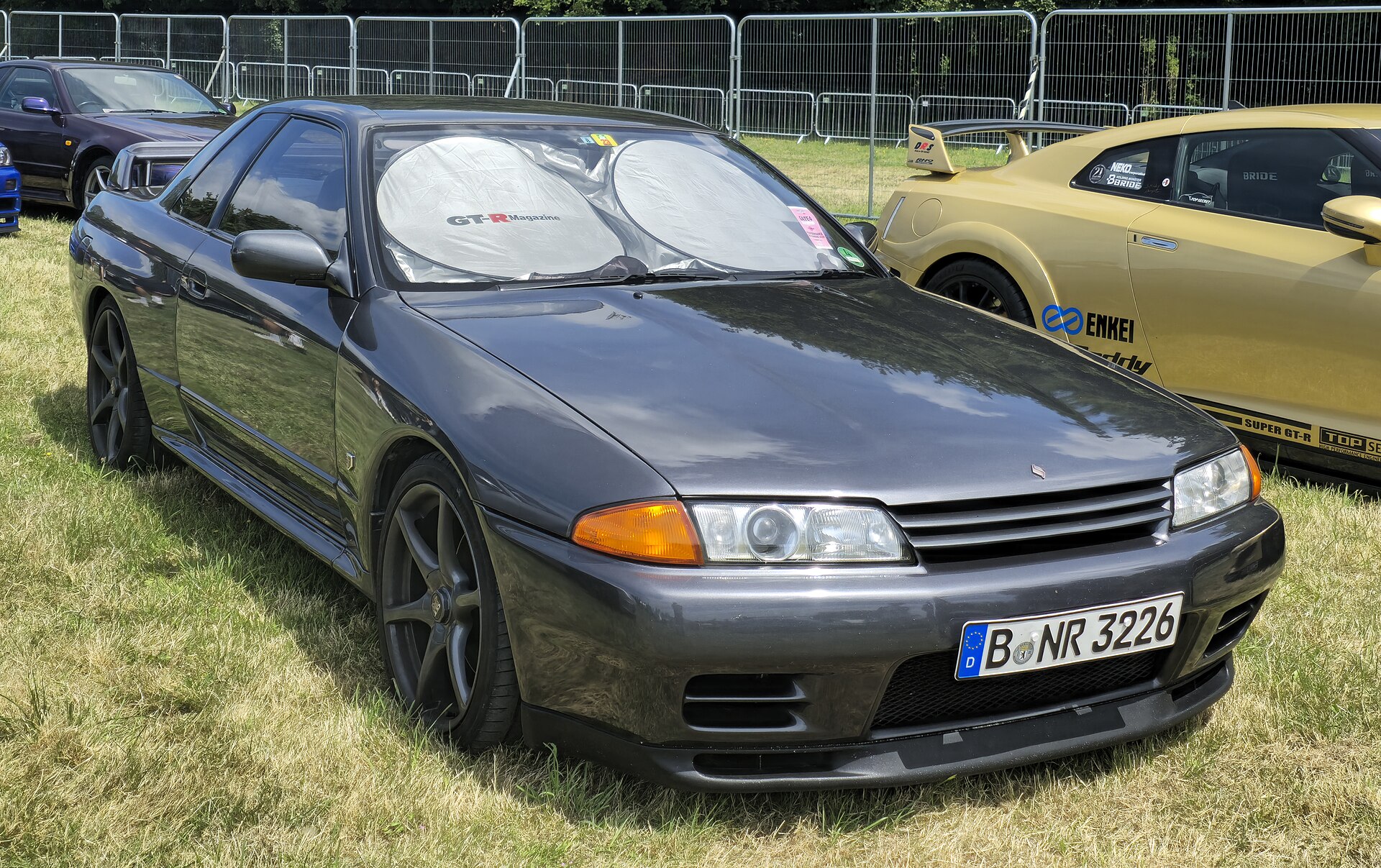
A €40,000 Car Lands at €63,000. Here Is Every Euro, and the Chassis Plate That Tells You Whether It Is a GT-R at All.
Two things sink Skyline imports, and neither is the one people worry about.
The first is the money: the hammer price is a little over half of what the car eventually costs, and almost nobody is told that before they bid. The second is worse — buying a car that is not the car it was advertised as. A Skyline GT-R and a Skyline GT-T look similar enough at a glance, cost wildly different money, and can be told apart in four seconds by anyone who knows where to look.
This guide covers both, in that order, with the arithmetic shown. It is written for Europe and Italy, with the US and UK positions summarised at the end.
The number nobody gives you
Take a clean R33 GT-R at €40,000 on the hammer in Japan. Here is what actually leaves your account.
| Building the customs value | € |
|---|---|
| Car, hammer price in Japan | 40,000 |
| Auction / agent fee | 1,200 |
| Inland transport in Japan + export paperwork | 600 |
| Sea freight, RoRo | 1,800 |
| Marine insurance | 400 |
| Customs value (CIF) | 44,000 |
Customs does not tax the car. It taxes everything it cost to get the car to the border — which is why a cheap shipping quote saves you less than it looks.
| Tax at the border | € |
|---|---|
| Duty, ~10% of customs value | 4,400 |
| Taxable base | 48,400 |
| Italian VAT, 22% | 10,648 |
| Landed | 59,048 |
Note the compounding: VAT is charged on the duty as well as on the car. Between them, the two take €15,048 — thirty-eight per cent of the car’s price, before you have turned a wheel.
| Then, to put it on the road | € |
|---|---|
| Customs broker | 500 |
| Port handling at destination | 600 |
| Homologation and compliance work | 2,000 – 4,000 |
| Registration and plates | 700 |
| On the road | 62,848 – 64,848 |
A €40,000 car costs €63,000–€65,000. Call it plus fifty-seven per cent, and treat that multiplier as the honest way to read any Japanese listing: whatever the screen says, add roughly six-tenths again.
These are indicative figures for a straightforward car into Italy — freight rates move, VAT differs by country, and a car needing more compliance work costs more. Get your own quotes for the freight and the broker before you bid. But the shape of the calculation does not change, and it is the shape that catches people out.
Is it actually a GT-R?
This is the section that saves real money, and it is missing from almost every import guide.
The Skyline is a model range, not a car. Most Skylines are ordinary saloons and coupés. The GT-R is one variant of it, and the difference between a GT-R and a well-presented lesser Skyline is tens of thousands of euros — which is exactly why the misrepresentation exists.
Badges unbolt. The chassis plate does not.
| Model | GT-R chassis code | Engine | Drive |
|---|---|---|---|
| R32 GT-R | BNR32 | RB26DETT | AWD |
| R33 GT-R | BCNR33 | RB26DETT | AWD |
| R34 GT-R | BNR34 | RB26DETT | AWD |
| R33 / R34 GT-T (not a GT-R) | ECR33 / ER34 | RB25DET | Rear-wheel drive |
Three checks, in order:
1. Read the chassis code, from the plate. Not from the advert, not from the badge — from a photograph of the plate in the engine bay, and from the export deregistration certificate. If a car is sold as an R34 GT-R and the code reads ER34, it is a GT-T. That single letter is the whole difference.
2. Count the turbos and check the drive. The GT-R’s RB26DETT is a twin-turbo straight six with ATTESA E-TS all-wheel drive. The GT-T’s RB25DET is a single-turbo straight six driving the rear wheels only. A “GT-R” with one turbo and no front driveshafts is not a GT-R, however convincing the bodykit.
3. Treat V-Spec, N1 and Nür claims as unproven until documented. These carry serious premiums and the badges are the easiest part to fit. Ask for the chassis number and the build documentation, and have your agent verify it against the model registry rather than the seller’s description.
You can check all of this before you ever contact a seller. Japanese export marketplaces — Goo-net Exchange among them — publish a model code field (型式) on every listing. Open a handful of cars advertised as GT-Rs and read it: a genuine one shows the code above. It costs two minutes, it uses the same listings your seller is using, and it is the cheapest due diligence in the entire process.
An agent who will not photograph the chassis plate is telling you something. Believe them.
Which one can you legally have?
United States. Federal rules exempt vehicles 25 years old or older from the safety standards a modern import must meet, with a separate, older threshold on the emissions side. The rule works by build date, not model year, so the arithmetic is simply month of manufacture plus twenty-five years.
That has a consequence worth spelling out. R32 GT-R production began in 1989 and R33 in 1995, so both have been eligible for years. The R34 GT-R was built from January 1999 to August 2002 — meaning eligibility has been arriving month by month, and the last cars come of age during 2027. If you are looking at a late R34, the build month is the whole story, and it is on the export certificate. Confirm the current federal position before you commit money; this is a moving target and the penalty for getting it wrong is a car that cannot enter the country.
Italy and the EU. Almost no Skyline was EU type-approved, so there is no Certificate of Conformity to present. That routes you to individual approval — the visita e prova — with the compliance work that goes with it: headlight beam pattern for right-hand drive, a rear fog lamp, a speedometer reading in km/h, glass and tyre markings, emissions checks case by case.
A car over twenty years old can also be put forward for historic classification — in Italy, ASI’s Certificato di Rilevanza Storica — which depends on originality and condition and can simplify the bureaucracy considerably. Every R32 and R33 now qualifies on age; whether a given car qualifies on originality is a different question, and heavy modification is what usually fails it.
United Kingdom. Imports go through customs declaration, duty and VAT, then a vehicle approval route, with older vehicles generally following a lighter path than new ones. The thresholds and the paperwork have changed more than once in recent years, so check the current government guidance rather than a forum post — including one written today.
Reading the auction sheet
Japanese auctions grade every car and publish a sheet. It is the single most useful document in the process, and most buyers see only the exporter’s summary of it.
Get the sheet itself, and get it translated in full. Not a paraphrase.
- Grade 4 to 4.5 — a well-kept car, minor issues possible
- Grade 3 to 3.5 — visible wear, cosmetic problems, more risk
- R or RA — repair history. The car has been damaged and mended.
An R-graded Skyline is not automatically a bad car; a properly repaired one can be sound. But you are paying collector money, and collector money should not buy an undocumented repair. If you go near an R car, demand photographs, measurements and invoices for the work — and if they do not exist, walk.
The sheet also carries a body diagram with the inspector’s marks: A for scratches, U for dents, W for repaired waves in a panel, C for corrosion, each with a severity number. Those letters are where the real story is, and they are exactly what a summary leaves out.
The Skyline-specific questions
Generic import advice stops at “get an inspection”. These are the things to actually ask about an RB-engined car, and the answers tell you who you are dealing with.
Has the oil pump drive been addressed? Early RB26 engines drive the oil pump from a narrow collar on the crank snout, and it is the best-known weak point in the engine’s reputation — particularly on cars that have seen high revs or added boost. A seller or specialist who knows the answer knows the engine.
Are the turbochargers original? Standard RB26 turbos use ceramic turbine wheels, and their long-term durability under raised boost is the other item every RB specialist will raise unprompted. Not a reason to walk away; a reason to know what you are buying.
Is the HICAS still there and working? The four-wheel-steering system is frequently deleted with a lock bar. That is a common and defensible modification — but if you are buying on originality, a deleted HICAS is a deviation, and it matters for a historic-vehicle application.
What does the boost gauge read, and why? Aftermarket boost controllers are near-universal on these cars. That is fine if disclosed and documented, and a problem if the car is sold as untouched.
Where are the shaken records? Japan’s periodic inspection generates a paper trail with the odometer reading recorded at each one. It is the closest thing to independent mileage verification you will get, and its absence on an otherwise well-documented car is a question worth pressing.
Rust, which is the one that actually ends cars
The idea that Japanese cars do not rust is a half-truth. Cars from coastal prefectures and from the snow regions, where roads are salted, rust like anything else — and a Skyline that spent thirty years near the sea can be structurally tired under very good paint.
Ask for underbody photographs on a lift, not three-quarter glamour shots. Look at the rear arches, the sills, the strut towers and the seams under the floor. A seller who will not put the car on a lift for you has made your decision.
The documents, none of which are optional
- Export / deregistration certificate — the Japanese paperwork proving the car has been removed from their register, and the primary source for chassis number and build date
- Bill of lading — the shipping document
- Commercial invoice — proof of the sale and its value, which customs will use
“We will send it later” is not an answer. Every one of these should exist before the car leaves Japan.
Where to buy
Through an auction agent. The widest choice, the least markup, and a graded sheet on every car. You are trusting the agent, so choose one with a traceable history of imports into your country and ask for references from buyers, not testimonials on their own site.
From an established Japanese exporter. Simpler and usually dearer, with condition reporting that varies by house.
From a marketplace listing. Easy to browse, and the quality of what sits behind the listing varies enormously.
Whichever route: pay for an independent inspection in Japan, arranged by someone who is not the seller and not being paid by the seller. On a €40,000 car it costs a rounding error and it is the only genuinely independent opinion you will get.
What actually goes wrong
Not the shipping. Shipping almost always works. Three other things account for most of the disasters:
The car was not the model advertised. Solved by the chassis plate, in four seconds, before any money moves.
The budget stopped at the hammer price. Solved by the first table in this article, and by getting freight and broker quotes before bidding rather than after.
The car cannot be registered. A heavily modified Skyline can be a fine car and still fail individual approval, and you discover this after it is standing on a dock in your name. If the goal is a road-registered car, buy the standard one and modify it afterwards — never the reverse.
Get those three right and importing a Skyline is an administrative exercise with a very good car at the end of it. Get one wrong and it becomes the most expensive lesson in the hobby.
Related reads: The Evolution of Skyline · How Fast & Furious Elevated the Nissan Skyline… · Top 5 Rarest GT-Rs · RB26DETT: Anatomy of a Legend · What a Supercar Costs to Own