Ferrari F80: The Most Powerful Ferrari Ever Built
The Ferrari F80 is the most powerful, most technologically advanced, and most expensive road car Ferrari has ever produced.
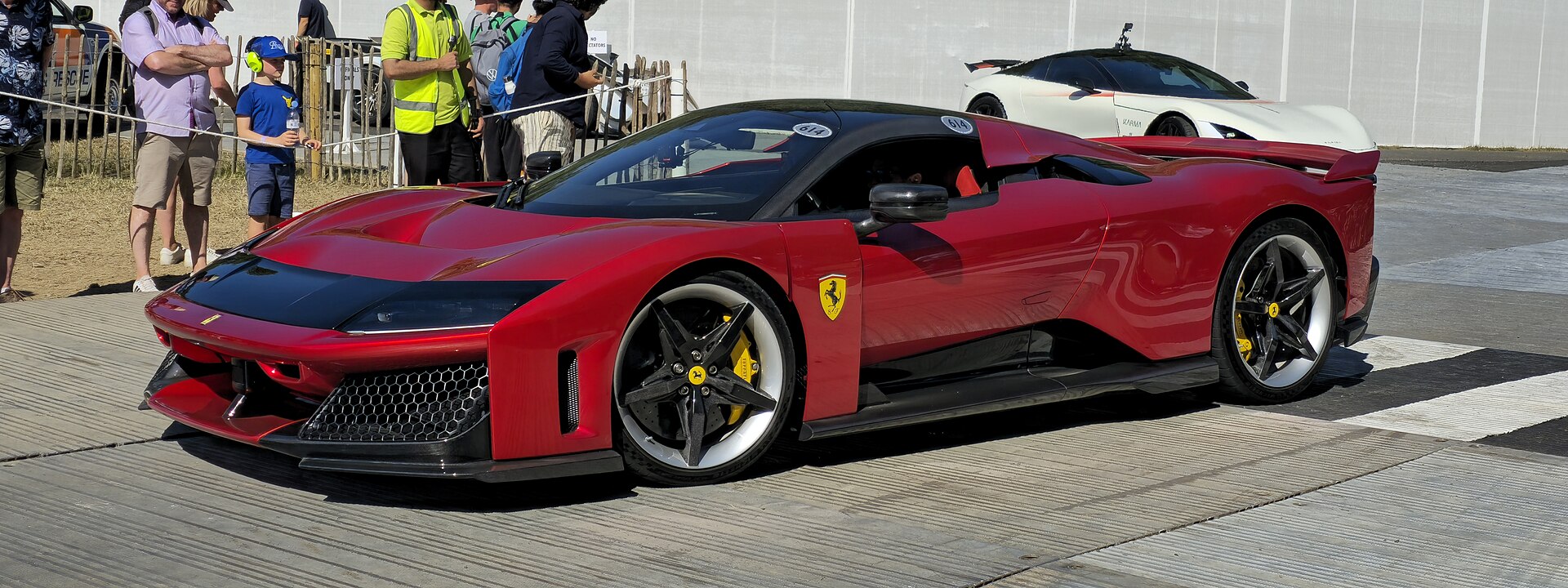
The Ferrari F80 is the most powerful, most technologically advanced, and most expensive road car Ferrari has ever produced. Unveiled on October 17, 2024, at the legendary Imola Circuit, the F80 succeeds the LaFerrari as Ferrari’s ultimate hypercar flagship — combining Le Mans-winning hybrid technology, Formula 1-derived aerodynamics, and 1,200 horsepower in a package that redefines what a Ferrari can be.
The Legacy: From F40 to F80
Every decade, Ferrari marks a milestone with a car that transcends ordinary supercar thinking. The F40 celebrated Ferrari’s 40th anniversary in 1987 and became the world’s first 200 mph road car. The F50 followed in 1995. The Enzo arrived in 2002. The LaFerrari in 2013 — forming one third of the legendary Hypercar Holy Trinity.
Now, for its 80th anniversary, Ferrari has created the F80 — the sixth member of this extraordinary lineage, and by every measurable standard the most extreme. Named to honor both the 80 years of Ferrari history since 1947 and the four decades since the legendary F40, the F80 carries an enormous heritage on its carbon fiber shoulders — and surpasses every predecessor completely.
Engine: A V6 That Produces 900 Horsepower Alone
The most controversial and most extraordinary element of the Ferrari F80 is its engine. For the first time in the history of Ferrari’s ultimate flagship hypercar, there is no V12. Instead, Ferrari has installed a 3.0-litre twin-turbocharged V6 — the Tipo F163 CF — derived directly from the Ferrari 499P, the prototype that won the 24 Hours of Le Mans in both 2023 and 2024.
This is not a compromise. It is a statement of intent. The F80’s V6, featuring a 120-degree bank angle and hot-V turbocharger placement, produces 900 horsepower on its own — an output of 300 horsepower per litre that is simply without precedent in a road car engine. It revs to 9,000 rpm and delivers a sound that Ferrari promises is unlike anything its road cars have produced before.
Three electric motors complete the powertrain — two on the front axle providing all-wheel drive, one at the rear contributing additional torque and energy recovery. Ferrari developed its electric motor entirely in-house in Maranello — the first time the company has done so — drawing directly on its Formula 1 programme for the tooth-coil stator, Halbach array rotor configuration, and carbon fibre magnet retention system. The 2.28 kWh, 800-volt battery powers the entire electric system.
Combined total output: 1,200 horsepower. The most powerful Ferrari ever built by a margin of 184 horsepower over the SF90 Stradale.
Key Performance Figures
| Specification | Detail |
|---|---|
| Engine | 3.0L Twin-Turbo V6 (F163 CF) + 3 Electric Motors |
| V6 Power | 900 hp at 9,000 rpm |
| Electric Power | 300 hp |
| Total Power | 1,200 hp |
| Specific Output | 300 hp per litre |
| Drivetrain | AWD (e-4WD front + MGU-K rear) |
| 0–62 mph | 2.15 seconds |
| 0–124 mph | 5.75 seconds |
| Top Speed | 217.5 mph (350 km/h) |
| Downforce at 155 mph | 1,050 kg (2,315 lbs) |
| Battery | 2.28 kWh, 800V lithium-ion |
| Production | 799 units (sold out) |
| Base Price (EU) | €3.6 million |
| Base Price (USA) | ~$4.0 million |
Aerodynamics: Le Mans Technology for the Road
If the engine is extraordinary, the aerodynamics of the Ferrari F80 are nothing short of revolutionary. Ferrari has transferred technology directly from the 499P Le Mans racer to the F80’s bodywork, creating the most aerodynamically efficient road car in the company’s history.
At 155 mph, the F80 generates 1,050 kg of total downforce — a figure that places it alongside dedicated racing machinery and makes it one of the most aerodynamically loaded road cars ever produced. The front bonnet features an S-Duct system with a triplane wing configuration, its curvatures and blower slots copied directly from the 499P. A full-width active rear wing deploys to manage downforce and drag continuously, adapting in real time to speed, braking, and cornering forces.
The underbody diffuser — measuring an extraordinary 180 cm in length — required Ferrari to rotate the entire engine-gearbox assembly by 1.3 degrees to maximize the expansion volume. This allows a massive flow of air to accelerate beneath the car, generating the low pressure area that creates rear downforce. A tyre seal system aerodynamically seals the underbody by blowing captured airflow into the wheel wells, further enhancing efficiency.
The braking system — co-developed with Brembo and designated CCM-R Plus — uses an industry first: longer carbon fibres that improve mechanical strength by 100% and thermal conductivity by 300%, with silicon carbide-coated braking surfaces for exceptional wear resistance. This is the most advanced carbon ceramic braking system ever fitted to a road car.
The Asymmetric Monocoque: A “1+” Interior
The Ferrari F80’s cabin is based on an asymmetric carbon fiber monocoque — a design solution unique in the hypercar world. Unlike the McLaren W1, where both seats are fixed to the chassis, the F80’s driver seat is fully adjustable. The passenger seat, however, is set slightly further back and trimmed in dark materials that cause it to visually disappear into the cabin — creating what Ferrari calls a “1+” configuration that emphasizes the driver’s primacy while technically accommodating a passenger.
The driver’s cockpit is entirely focused on performance. A new, smaller steering wheel — flattened at top and bottom, with a reduced boss for better visibility — features physical buttons on its spokes, allowing the driver to locate controls by touch without removing their eyes from the road. This marks a deliberate step back from the capacitive touch interfaces of recent Ferraris — the same philosophy seen in the new Amalfi Spider, prioritizing function over aesthetic.
There is no central infotainment screen dominating the cabin. The F80’s interior is deliberately sparse, purposeful, and beautiful — a space that communicates its racing DNA in every surface and texture.
Design: The F40 Reborn for the 21st Century
Visually, the Ferrari F80 draws its most significant inspiration from the F40 — the car that defined Ferrari’s 40th anniversary and remains one of the most loved and most recognizable Ferraris ever built. The black band across the bonnet echoes the Ferrari 365 GTB/4 Daytona. The panoramic windscreen references the F50. Eight longitudinal slats on the engine cover — one for each decade of Ferrari’s existence — serve as an Easter egg for those who know to look.
The overall architecture is defined by a dihedral cross section with its lower corners planted firmly over the wheels — a shape that appears simultaneously aggressive and aerodynamically inevitable. Butterfly doors open dramatically to allow entry into the tight, driver-focused cockpit. The massive rear wing — the centrepiece of the adaptive aerodynamics system — dominates the rear three-quarter view and leaves no question about the F80’s intentions.
Price, Exclusivity and the Sellout Before Reveal
At €3.6 million (approximately $4.0 million USD), the Ferrari F80 is the most expensive production Ferrari in the company’s history — more than double the price of the LaFerrari at launch, and significantly more than the McLaren W1 at $2.1 million. Only the Bugatti Tourbillon at $4.1 million stands above it in this extraordinary price bracket.
Ferrari limited production to 799 units — mirroring the SF90 XX Stradale’s production run — with manufacturing scheduled to run from late 2025 through 2027. Every single allocation was claimed before the car was even officially unveiled. On the secondary market, early estimates suggest F80 values could reach $5 million or more — continuing the upward trajectory of every previous Ferrari flagship, as our supercar investment guide documents.
Ferrari F80 vs. The New Holy Trinity
The F80, McLaren W1, and Porsche Mission X represent the new generation of the Holy Trinity — the successor to the legendary P1, LaFerrari, Porsche 918 Spyder battle of the early 2010s.
Of the three, the Ferrari F80 is the fastest to 62 mph at 2.15 seconds, beating the McLaren W1’s 2.7 seconds convincingly. It also generates dramatically more downforce than either rival. The McLaren counters with a purer, rear-wheel drive character and a lower price. The Porsche Mission X, not yet fully revealed, promises an electric-only powertrain that will redefine the parameters of the comparison entirely.
Against the Bugatti Tourbillon, the F80 is less powerful by 600 horsepower but costs slightly less and offers a driving experience more explicitly connected to Ferrari’s racing programme. Against the Lamborghini Revuelto, the F80 is in an entirely different price category — but represents a fundamentally different vision of what a hypercar should be.
Why the Ferrari F80 Matters
The Ferrari F80 matters because it answers the most difficult question Ferrari has ever faced: how do you follow the LaFerrari?
The answer, it turns out, is to abandon the V12, embrace Le Mans technology, hire the world’s best aerodynamicists, and produce 1,200 horsepower from 3.0 litres of displacement. It is a bold, brave, and technically extraordinary response — one that will divide opinion among Ferrari purists who mourn the V12, while simultaneously stunning every engineer and performance enthusiast who studies what Ferrari has achieved.
The F40 was the greatest Ferrari of the 1980s. The LaFerrari was the greatest of the 2010s. The F80 has every intention of being the defining Ferrari of the 2020s — and on the evidence presented so far, it will succeed completely.
Would you choose the Ferrari F80 over the McLaren W1 or the Bugatti Tourbillon? Let us know in the comments below!
Related reads: LaFerrari · Ferrari F40 · Ferrari F50 · Ferrari Enzo · SF90 Stradale · SF90 XX Stradale · Amalfi Spider · The Holy Trinity · Ferrari: The Complete History