Pininfarina Battista: The Silent Hypercar Revolution
Introduction — The Loudest Hypercar Ever Made Has No Engine Sound For more than a century, automotive power was defined by noise. The louder the engine, the greater the perceived strength.
Introduction — The Loudest Hypercar Ever Made Has No Engine Sound
For more than a century, automotive power was defined by noise. The louder the engine, the greater the perceived strength. The deeper the exhaust note, the more emotional the machine felt. Sound was not just a byproduct — it was identity. The Pininfarina Battista destroys that idea. It is one of the most powerful hypercars ever created, yet it makes almost no sound. Its existence forces a philosophical shift: if power no longer roars, how do we recognize it? The Battista is not simply an electric hypercar. It is the moment when performance became silent.
Why the Battista Exists
Pininfarina was never a manufacturer. It was a design house. For decades, it shaped the most beautiful cars in the world for others: Ferrari, Alfa Romeo, Maserati, Peugeot, Lancia. The Battista is Pininfarina’s declaration of independence. It is the first time the company decided to express its own identity not through lines, but through a complete machine. This makes the Battista more than a car. It is a statement of authorship.
Electric Power Without Apology
Most electric cars justify themselves through efficiency. The Battista does not. It does not exist to save the planet. It exists to dominate physics. With nearly 2,000 horsepower available instantly, the Battista does not build speed. It releases it. Acceleration is not progressive. It is violent. But unlike combustion violence, it is perfectly smooth. This creates a new kind of intensity: not chaotic, but overwhelming.
Torque as a Structural Force
The Battista does not use torque to move. It uses torque to reshape reality. Electric motors deliver maximum torque from zero RPM. That means the Battista does not accelerate — it catapults. This changes how the driver experiences motion. There is no buildup. There is only consequence.
The End of Mechanical Drama
Traditional hypercars create drama through:
- Sound
- Vibration
- Gear changes
- Mechanical resistance
The Battista removes all of this. What remains is pure force. This is disturbing to some. Liberating to others. It reveals that much of what we loved about performance was not speed — it was theatre. The Battista removes the theatre. Only the physics remain.
A New Aesthetic of Performance
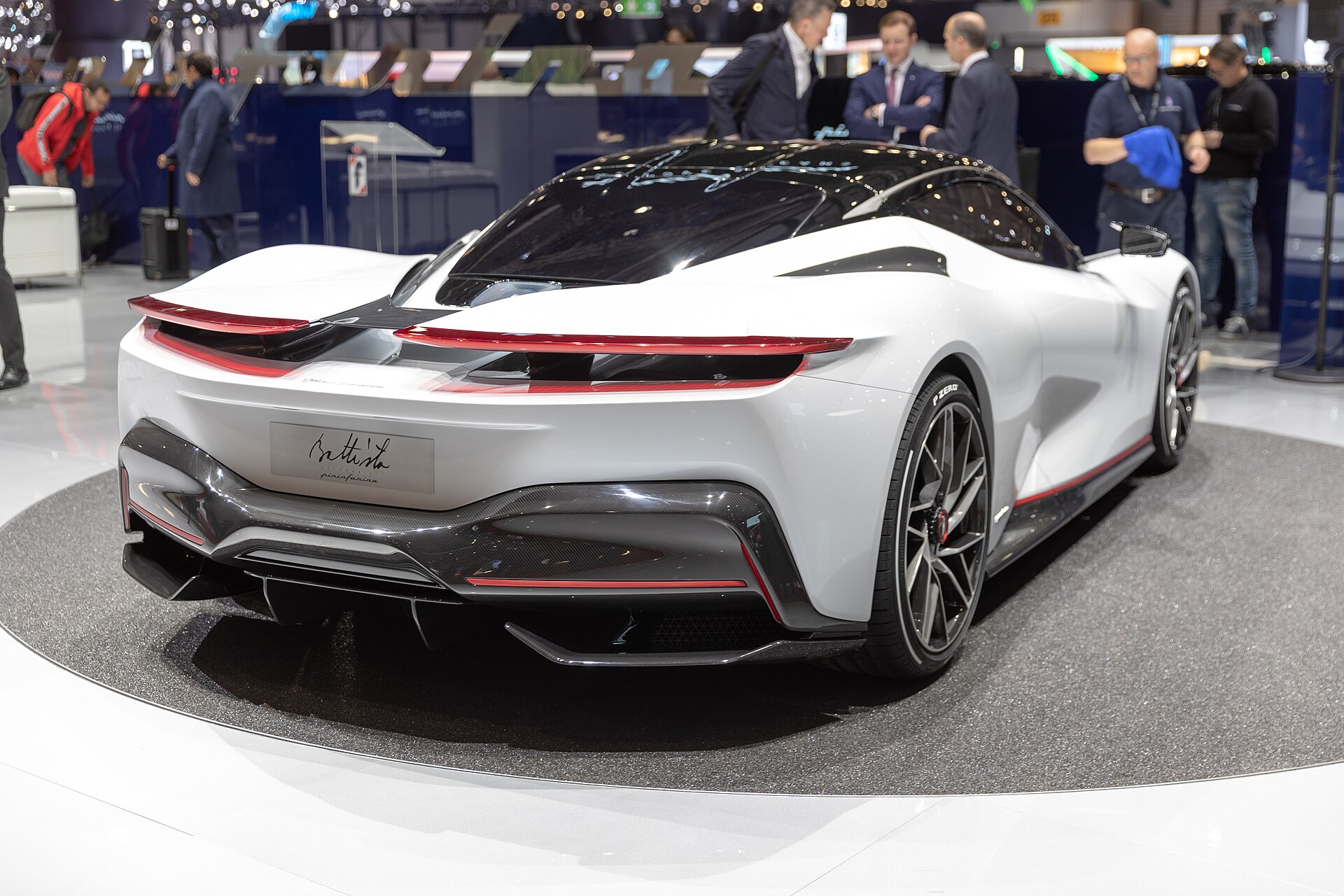
Without the need for cooling massive engines, without exhaust systems, without traditional layouts, the Battista’s design is radically clean. Air flows around it with clarity. Its shape is not aggressive. It is controlled. The Battista does not threaten. It asserts.
The Psychological Impact
Driving a Battista is not heroic. It is humbling. It reminds the driver that human reflexes are slower than electrons. The machine is always ahead. You do not command the Battista. You negotiate with it.
Cultural Meaning
The Battista marks the moment when Italian performance culture entered the electric age. Not reluctantly. Not defensively. But proudly. It says: elegance does not disappear when pistons vanish. It transforms.
Conclusion — The Hypercar After the Hypercar
The Battista is not the future of hypercars. It is the end of hypercars as we understood them. After the Battista, loudness is optional. Violence is digital. Emotion is silent. Power is no longer something you hear. It is something you survive.
Technical Specifications — Pininfarina Battista
Pininfarina Battista: manufacturer Automobili Pininfarina; production years 2022–present; production units limited to 150; layout four electric motors, all-wheel drive; power output approx. 1,900 hp and 2,300 Nm of torque; 0–100 km/h in approx. 1.86 s; 0–200 km/h in under 5 s; top speed 350 km/h; battery 120 kWh lithium-ion; transmission single-speed per motor; chassis carbon fiber monocoque; kerb weight approx. 2,100 kg; suspension double wishbone front and rear with adaptive dampers; brakes carbon-ceramic discs; aerodynamics active aerodynamic elements with adaptive rear wing.
Related reads: The Evolution of Supercars · The Fastest Cars in the World in 2026 · F1 Tech’s Impact on Hypercar Performance