Pagani Utopia: The $2.5 Million Hypercar That Defies the Future
In 2022, Horacio Pagani unveiled his third car. Not in a convention center. Not at a motor show. He unveiled it in a museum — surrounded by six original drawings by Leonardo da Vinci.
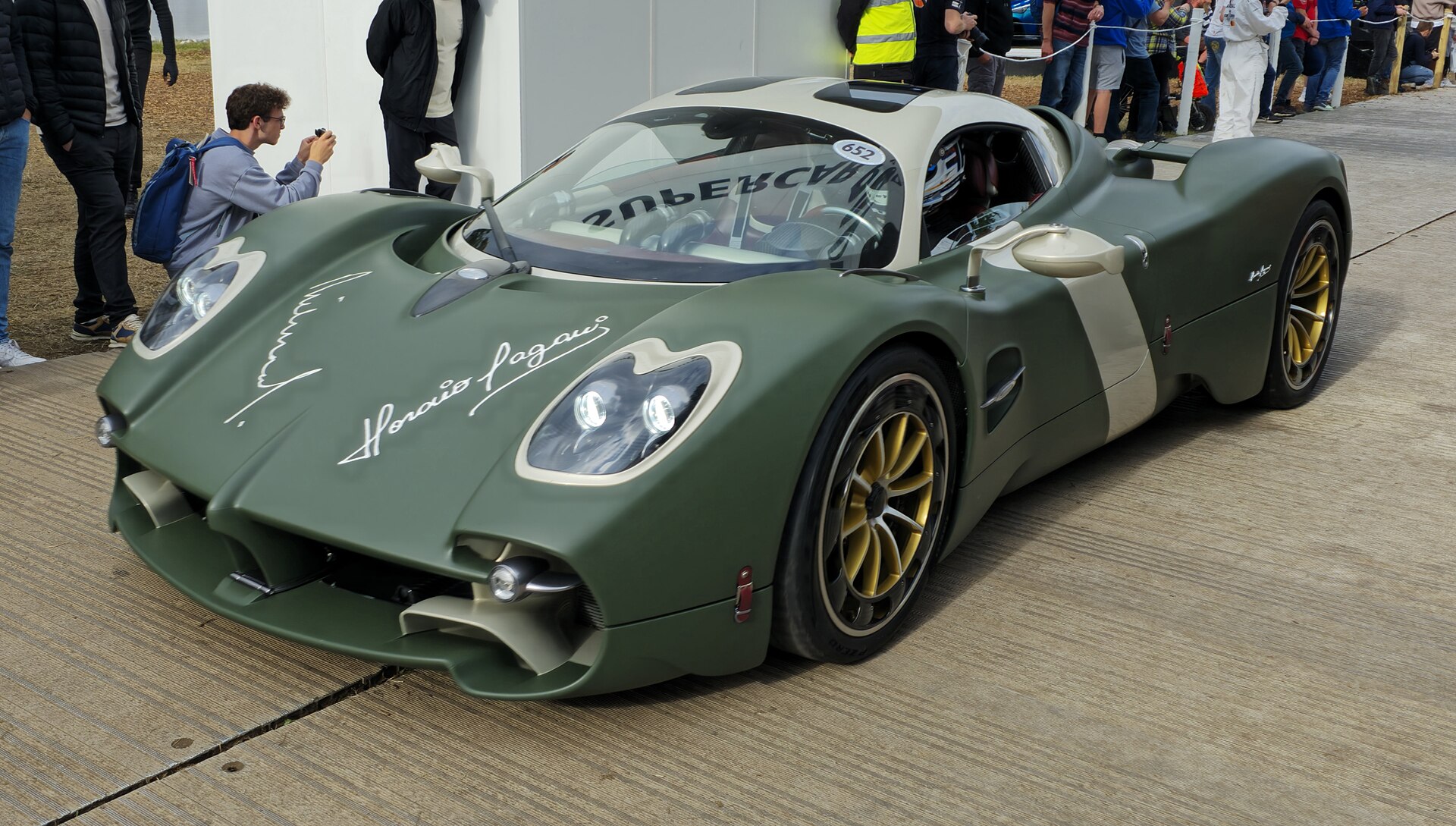
In 2022, Horacio Pagani unveiled his third car. Not in a convention center. Not at a motor show. He unveiled it in a museum — surrounded by six original drawings by Leonardo da Vinci.
That tells you everything you need to know about the Pagani Utopia.
What Does “Utopia” Mean?
A utopia is a perfect place that doesn’t exist. It’s an ideal — something to dream about but never reach. Horacio Pagani chose this name deliberately. The Utopia is not just a hypercar. It is his vision of what a car should be. A place where beauty, engineering, and the driver are perfectly united.
After six years of development, four thousand sketches, twelve scale models, and eight complete prototypes, the Utopia was revealed on September 12, 2022, at the Teatro Lirico in Milan. All 99 units were sold before most people even saw a photograph.
Horacio Pagani: The Man Behind the Dream
To understand the Utopia, you need to understand its creator.
Horacio Pagani was born in 1955 in Casilda, Argentina. As a teenager, he became obsessed with Lamborghini. At age 20, he wrote a letter to Ferruccio Lamborghini asking for a job. He was rejected. He wrote again. Rejected again. He moved to Italy anyway, learned Italian, and eventually got a job at Lamborghini in 1983 as a composite materials engineer.
He worked on the Lamborghini Countach and Diablo. He convinced Lamborghini to use carbon fiber — something almost no road car manufacturer was doing at the time. But Lamborghini didn’t share his vision for a new car.
So in 1992, Pagani left and founded his own company — Pagani Automobili — in Modena, Italy, the same city as Ferrari and Lamborghini. His first car, the Pagani Zonda, launched in 1999. It was unlike anything anyone had seen before. The Huayra followed in 2011.
The Utopia is his third car. He has now been building hypercars for over 25 years, and he still designs every detail personally.
The Philosophy: Against the Trend
In 2022, every other hypercar manufacturer was going hybrid or fully electric. Ferrari launched the SF90 Stradale. Lamborghini announced the hybrid Revuelto. McLaren built the hybrid Artura. Even Bugatti’s successor, Rimac, is electric.
Pagani went the opposite direction.
The Utopia has no electric motors. No hybrid system. No all-wheel drive. No launch control. It is a rear-wheel-drive, naturally-combusted, V12-powered machine. You either master it, or it masters you.
Horacio Pagani made a statement with the Utopia: some experiences cannot be improved by technology. The soul of driving is the connection between human and machine — and that connection requires honesty, difficulty, and reward.
The Engine: Mercedes-AMG V12
Since the very first Zonda in 1999, Pagani has used V12 engines built by Mercedes-AMG. The relationship has lasted over 25 years.
The Utopia’s engine is a 6.0-liter twin-turbocharged V12, specially developed for Pagani by AMG. It produces 864 horsepower and 1,100 Nm (811 lb-ft) of torque — the same torque figure as the ultra-rare Huayra Tricolore, which cost over $8 million.
Power arrives to the rear wheels only, through one of two available gearboxes. This is where things get extraordinary.
The Gearbox: A Real Manual in a $2.5M Hypercar
Pagani offered buyers a choice that no other hypercar manufacturer dared to offer: a real, mechanical, six-speed manual gearbox with a gated shifter — the kind with metal slots that click into place for each gear.
The last time most supercars offered a manual was in the early 2000s. Modern hypercars use dual-clutch automatics for faster lap times. But Pagani’s customers asked for a manual. Building one capable of handling 1,100 Nm of torque required years of engineering. Pagani did it anyway.
The alternative is a seven-speed automated single-clutch gearbox, similar to the Huayra’s. But Pagani reported that approximately 80% of buyers chose the manual.
This is perhaps the most radical statement in the entire hypercar industry: the most expensive, most exclusive cars on earth, and most customers said give me the stick shift.
The Body: Art and Science in Carbon Fiber
The Utopia’s body is made entirely of carbon fiber. The chassis uses a blend of carbon fiber and titanium. Dry weight is 1,280 kg (2,822 lbs) — 70 kg lighter than the standard Huayra.
The design was drawn entirely by Horacio Pagani. There are no sharp edges, no aggressive cuts. The Utopia is organic, almost biological. The front features four round headlights. The roofline flows in a long, smooth curve. At the rear, four titanium exhaust pipes exit through the center of the bodywork — a Pagani signature since the Zonda.
One unusual detail: the roof features a split window, dividing the glass into two sections. This is a reference to classic Italian coach-built cars of the 1950s.
The interior continues the philosophy of “art and science.” Every button, every switch, every dial is machined from aluminum or titanium. There is real leather, hand-stitched. There are analog gauges for oil temperature, oil pressure, water temperature, and turbocharger pressure — four separate gauges on the center console. A small TFT screen provides digital information.
Nothing is touched by cheapness. Nothing is mass-produced.
Performance and Top Speed
With 864 hp and 1,280 kg, the performance numbers are predictably impressive. The Utopia accelerates from 0 to 100 km/h in approximately 2.7 seconds. Top speed is 370 km/h (230 mph).
These figures are not the fastest in the hypercar world — the Bugatti Chiron is quicker, the Koenigsegg Jesko is faster. But that is not the point of the Utopia. The point is the experience of getting there. The sound of the V12 at 6,700 rpm. The feel of the gated shifter. The sensation of rear-wheel drive at its absolute limits.
Production: 99 Coupés and 130 Roadsters
Pagani’s factory in San Cesario sul Panaro, near Modena, produces approximately 50 cars per year across all models. This is not an assembly line — it is an atelier. Each car takes months to build.
The Utopia Coupé is limited to 99 units. The first car was delivered in October 2023. All 99 units were already assigned to customers before the car was officially unveiled.
The Utopia Roadster was announced on July 30, 2024, with production limited to 130 units. Like the coupé, the roadster adds no weight despite removing the roof — a remarkable engineering achievement.
Base price for the Coupé is $2.19 million USD. With customization — which every Pagani buyer pursues — final prices commonly exceed $3 million.
The Reveal: Da Vinci’s Company
The choice of venue for the Utopia’s reveal was not accidental. Horacio Pagani unveiled the car in the National Science and Technology Museum “Leonardo da Vinci” in Milan, surrounded by six original drawings by the Renaissance master — loaned specifically for the event.
Pagani has always described his work as “Art and Science.” Da Vinci embodied both in a single person: engineer, painter, architect, inventor. The parallel was intentional, and it was unmistakable.
The name of the car, the choice of venue, the manual gearbox, the rejection of electrification — all of it adds up to a single message: some things should remain as they are. Some experiences do not need to be improved. Some cars should be built to be felt, not just driven fast.
Specifications at a Glance
| Spec | Details |
|---|---|
| Engine | 6.0L Twin-Turbo V12 (Mercedes-AMG) |
| Power | 864 hp @ 6,700 rpm |
| Torque | 1,100 Nm (811 lb-ft) |
| Gearbox | 6-speed manual OR 7-speed auto |
| Drivetrain | Rear-wheel drive |
| Weight | 1,280 kg (dry) |
| 0–100 km/h | ~2.7 seconds |
| Top Speed | 370 km/h (230 mph) |
| Production | 99 Coupés + 130 Roadsters |
| Price | From $2.19 million USD |
Conclusion: The Last of Its Kind
The Pagani Utopia may be the last pure V12, rear-wheel-drive, manual-gearbox hypercar ever built at this level. Regulations tighten every year. CO2 limits become stricter. The world moves toward electrification.
Horacio Pagani knew this when he built the Utopia. He built it anyway — perhaps because of it. The Utopia is not a compromise between the past and the future. It is a celebration of what cars can be when no compromise is made at all.
That is why it is a utopia. A perfect place. One that Horacio Pagani built with his own hands — and managed to make real.
Related reads: Pagani Hypercars · How Pagani and Koenigsegg Redefined Supercar…