Legends of 90s JDM Performance Cars
When people think of 1990s Japanese performance, the Nissan Skyline GT-R usually hogs the spotlight. With its "Godzilla" nickname and dominant ATTESA E-TS All-Wheel Drive system, it’s easy to see why.
When people think of 1990s Japanese performance, the Nissan Skyline GT-R usually hogs the spotlight. With its “Godzilla” nickname and dominant ATTESA E-TS All-Wheel Drive system, it’s easy to see why. However, the 90s were a period of unprecedented technological warfare between Japanese manufacturers.
While Nissan was perfecting the GT-R, other brands were taking entirely different paths to automotive perfection. From mid-engine precision to rotary-powered art and bulletproof inline-sixes, here are the legends that defined an era.
1. The Ferrari Killer: Honda NSX (NA1/NA2)
In the late 1980s, Honda didn’t just want to build a fast car; they wanted to embarrass the European elite. The NSX (New Sportscar eXperimental) was designed with one target in mind: the Ferrari 348.
The Senna Legacy
The development of the NSX is legendary because of one man: Ayrton Senna. During testing at Suzuka, the F1 champion famously told Honda engineers that the chassis felt “fragile.” This led Honda to increase the car’s rigidity by 50%. The result was a car with a surgical level of handling that redefined what a mid-engine supercar could be.
Innovation Over Brute Force
- All-Aluminum Construction: It was the world’s first production car to feature an all-aluminum semi-monocoque body, saving nearly 200kg.
- The Engine: A 3.0L (and later 3.2L) V6 featuring VTEC technology. While it “only” produced around 270–290 hp due to the Japanese Gentlemen’s Agreement, its 8,000 RPM redline provided a mechanical soundtrack that rivaled Maranello’s best.
- Ergonomics: The cockpit was inspired by the F-16 fighter jet, offering 360-degree visibility—a rarity in the supercar world.
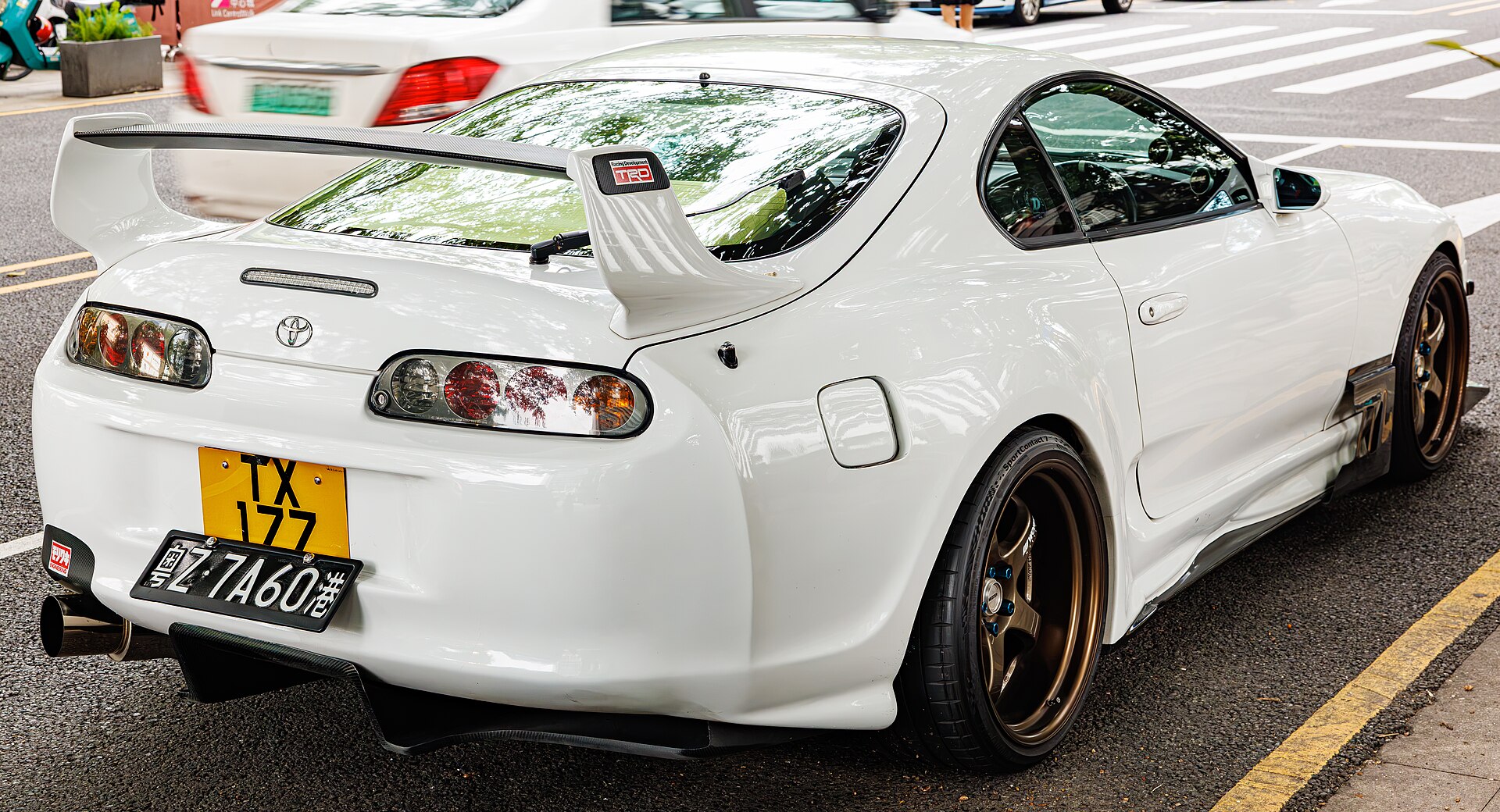
2. The Overbuilt Icon: Toyota Supra (A80)
If the NSX was a scalpel, the Mk4 Supra was a sledgehammer wrapped in silk. Launched in 1993, the A80 Supra was Toyota’s attempt to create the ultimate Grand Tourer.
The Heart: The 2JZ-GTE
The legend of the Supra isn’t just about the car itself, but the engine under the hood. The 2JZ-GTE is arguably the most famous engine in history. Featuring a cast-iron block and forged internals from the factory, it was absurdly over-engineered. While it officially left the factory with 280 hp (for the Japanese market), tuners quickly discovered that with a larger turbo and a fuel system upgrade, the 2JZ could reliably produce 800 to 1,000 hp without opening the engine block.
Cultural Domination
The Supra became a global phenomenon after its starring role in the 2001 film The Fast and the Furious. It transitioned from a respected sports car to a cultural icon, representing the “highway king” that could outrun almost anything on a straight line.
3. The Rotary Masterpiece: Mazda RX-7 (FD3S)
The Mazda RX-7 FD is widely considered one of the most beautiful cars ever designed. Unlike the muscular Supra or the clinical NSX, the RX-7 was an exercise in lightweight agility and unconventional engineering.
The Wankel Magic
At its core was the 13B-REW, a twin-turbocharged rotary engine. Because it used rotors instead of pistons, the engine was incredibly compact and light. This allowed Mazda to push the engine far back in the chassis, achieving a perfect 50:50 weight distribution. The FD featured a complex sequential turbocharging system: one turbo provided boost at low RPM, while the second kicked in at high RPM to provide a seamless, jet-like surge of power.
Pure Driving Dynamics
The RX-7 was a purist’s car. It was light (around 1,200 kg) and featured a sophisticated double-wishbone suspension. It didn’t rely on electronic aids; it relied on balance. Even today, few cars can match the tactile steering feel and “on-rails” cornering of a well-sorted FD.
4. The Tech Pioneer: Mitsubishi 3000GT VR-4
While often overlooked, the Mitsubishi 3000GT (known as the GTO in Japan) was the most technologically advanced car of the group. It was a “spaceship on wheels” that featured:
- Active Aerodynamics: Automatically adjusting front and rear spoilers.
- All-Wheel Steering: The rear wheels turned slightly to aid high-speed stability.
- Electronic Controlled Suspension: Adjusting dampening on the fly.
- Active Exhaust: A button to change the car’s sound from “Touring” to “Sport.”
It was heavy, but it showcased a vision of the future that we now see in modern hypercars from brands like McLaren and Porsche.
Conclusion: A Legacy of Choice
The 90s JDM era was special because every manufacturer had a different “religion.”
- Honda believed in balance and VTEC.
- Toyota believed in bulletproof power.
- Mazda believed in lightweight rotary innovation.
- Nissan believed in AWD technological dominance.
Today, these cars aren’t just “used vehicles”; they are blue-chip investments. Prices for clean NSX or Supra models have soared past $100,000, proving that while they may have been “Godzilla’s” rivals, they are now legends in their own right.
| Model | Engine Type | Drivetrain | Power (HP) | 0-100 km/h | Top Speed | Curb Weight |
|---|---|---|---|---|---|---|
| Nissan Skyline GT-R (R34) | 2.6L RB26DETT I6 Twin-Turbo | AWD | 280* | 4.8s | 250 km/h** | 1,560 kg |
| Honda NSX (NA2) | 3.2L C32B V6 N/A | RWD | 290 | 5.7s | 270 km/h | 1,445 kg |
| Toyota Supra (A80) | 3.0L 2JZ-GTE I6 Twin-Turbo | RWD | 320+ | 4.6s | 250 km/h** | 1,550 kg |
| Mazda RX-7 (FD3S) | 1.3L 13B-REW Rotary Twin-Turbo | RWD | 280 | 5.1s | 250 km/h** | 1,280 kg |
| Mitsubishi 3000GT VR-4 | 3.0L 6G72 V6 Twin-Turbo | AWD | 320 | 5.8s | 256 km/h | 1,725 kg |
We all have that one car that started our obsession. Was it a silver R34 in a movie, or an RX-7 screaming in a video game? Share your first JDM memory with us below—we want to hear your story!”
Related reads: The Battle of Giants · How Fast & Furious Elevated the Nissan Skyline… · Nissan Skyline History