Unleashing the Porsche Carrera GT: A Masterclass in Engineering
Some supercars impress you with numbers. The Porsche Carrera GT impresses you with engineering intent: a road car built with motorsport logic, wrapped in carbon fiber, powered by a screaming naturally aspirated V10, and tied to yo…
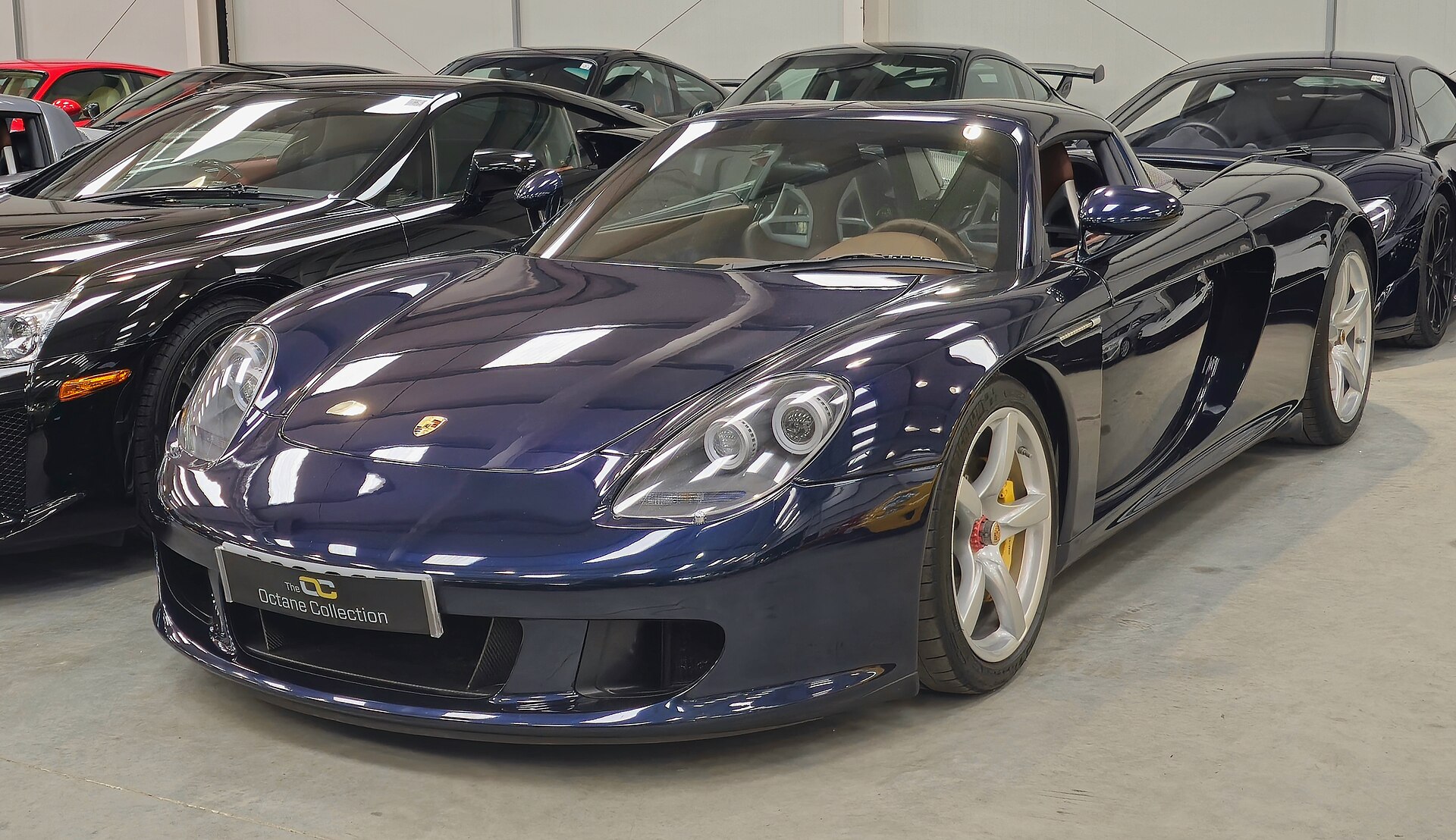
Some supercars impress you with numbers. The Porsche Carrera GT impresses you with engineering intent: a road car built with motorsport logic, wrapped in carbon fiber, powered by a screaming naturally aspirated V10, and tied to you with a 6-speed manual and one of the most exotic clutches ever fitted to a production car. Even today, it stands as a peak-era symbol of the “analog” supercar—fast, demanding, and deeply mechanical.
In an age of hybrid torque-fill and dual-clutch perfection, the Carrera GT remains something rarer: a machine that rewards skill and respect more than bravado.
Why the Carrera GT became a legend
The Carrera GT’s reputation isn’t hype—it’s the combination of choices Porsche made that now look almost impossible to repeat:
- Naturally aspirated V10 that loves revs (and sounds like nothing else).
- Manual gearbox only, with a distinctive, high-precision shift feel.
- Carbon-fiber monocoque and bodywork, engineered for stiffness and low mass.
- Ceramic composite clutch and ceramic brakes—race-bred solutions brought to the street. (Porsche Newsroom)
This isn’t a car you “use.” It’s a car you learn.
Engineering deep-dive (the cool parts enthusiasts talk about)
The V10 that came from racing DNA
The Carrera GT uses a 5.7-liter (5,733 cc) naturally aspirated V10 producing 450 kW (612 PS) at 8,000 rpm, with 590 Nm at 5,750 rpm. (Porsche Newsroom)
It revs to an 8,400 rpm redline, which is a big part of why the driving experience feels so intense and “alive.” (Wikipedia)
The clutch: tiny, exotic, and very “Carrera GT”
It’s paired to a 6-speed manual with a ceramic clutch (Porsche Ceramic Composite Clutch / PCCC). This system was designed to reduce rotating mass and sharpen response—one reason the car feels so immediate, but also why it demands smooth technique at low speed. (Porsche Newsroom)
The structure: carbon everywhere that matters
A carbon monocoque isn’t just for bragging rights—it defines the whole car’s feel: rigidity, steering clarity, and that sense that everything is connected through the chassis. Porsche positioned the Carrera GT as a technical milestone built around lightweight construction and the mid-engine principle. (Porsche Newsroom)
Performance: still fast by modern standards, but delivered differently
Official figures are still eye-opening:
- 0–100 km/h: 3.9 s
- 0–200 km/h: 9.9 s
- Top speed: 330 km/h (Porsche Newsroom)
But the bigger story is how it makes speed: linear power, rising intensity with revs, and a feeling of momentum building—rather than instant electric shove.
Technical specs
Powertrain
- Engine: 5.7L (5,733 cc) NA V10, 68°
- Power: 450 kW (612 PS) @ 8,000 rpm
- Torque: 590 Nm @ 5,750 rpm
- Transmission: 6-speed manual, ceramic clutch (PCCC) (Porsche Newsroom)
Performance
- 0–100 km/h: 3.9 s
- 0–200 km/h: 9.9 s
- Top speed: 330 km/h (Porsche Newsroom)
Dimensions & weight
- Length / Width / Height: 4,613 / 1,921 / 1,166 mm
- Wheelbase: 2,730 mm
- Kerb weight: 1,380 kg (Porsche Newsroom)
Production
- Built: 2003–2006
- Total: 1,270 units
- Factory: Leipzig (Porsche Newsroom)
What it’s like to drive (and why it’s “analog”)
The Carrera GT is famous for being rewarding but not forgiving. The controls have real weight, the feedback is rich, and the car communicates constantly—through the steering, chassis, and even the way the engine responds to tiny throttle changes.
It’s the kind of car where:
- Smooth inputs make it feel telepathic.
- Rushed inputs make it feel serious.
That’s exactly why so many enthusiasts call it one of the last truly great driver-focused supercars.
Final thought
The Porsche Carrera GT isn’t just a collectible—it’s a moment in automotive history when a manufacturer decided to build something uncompromising: carbon structure, motorsport engineering, a high-revving V10, and a manual gearbox as the only option. The result is a car that still feels special because it still feels human.
Call to action
If you could drive a Carrera GT for one day, where would you take it—and why?
Drop your answer in the comments, and if you want more deep-dive supercar articles like this (specs, engineering, history, driving feel), subscribe to the blog and follow SupercarsPassion for the next post.
Related reads: Porsche Carrera GT · Top 3 Daily-Drivable Supercars · Porsche 911 Turbo S T-Hybrid