Porsche Carrera GT: An Analog Supercar Masterpiece
Some supercars impress you with numbers. The Porsche Carrera GT impresses you with engineering intent. It is a road car built with motorsport logic and wrapped in carbon fiber.
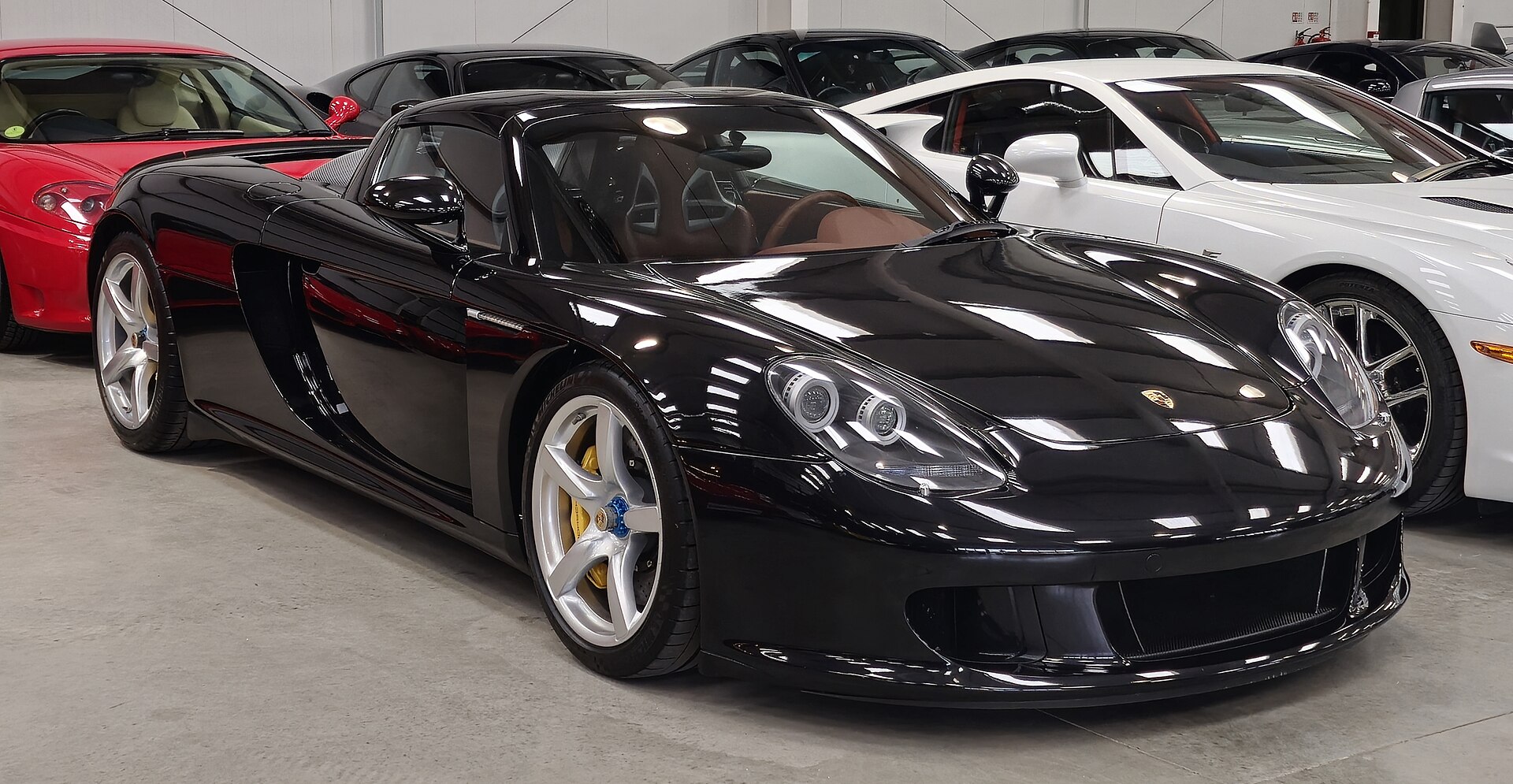
Some supercars impress you with numbers. The Porsche Carrera GT impresses you with engineering intent.
It is a road car built with motorsport logic and wrapped in carbon fiber. It is powered by a screaming naturally aspirated V10 linked to you with a 6-speed manual and one of the most exotic clutches ever fitted to a production car. Even today, it stands as a peak-era symbol of the “analog” supercar — fast, demanding, and deeply mechanical.
In an age of hybrid torque-fill and dual-clutch perfection, the Carrera GT stands out as something rarer: a machine that rewards skill and respect more than bravado. Porsche built it to prove that racing technology could live on the road — the same philosophy that would later produce the 918 Spyder.
Why the Carrera GT became a legend
The Carrera GT’s reputation isn’t hype — it’s the combination of choices Porsche made that now look almost impossible to repeat: a naturally aspirated V10 that loves revs, a manual gearbox only with a distinctive shift feel, a carbon-fiber monocoque engineered for stiffness and low mass, and a ceramic composite clutch with ceramic brakes — race-bred solutions brought to the street.
This isn’t a car you “use.” It’s a car you learn.
The V10 that came from racing DNA
The Carrera GT uses a 5.7-liter naturally aspirated V10 producing 612 hp at 8,000 rpm, with 590 Nm at 5,750 rpm, revving to an 8,400 rpm redline. The engine was derived from a Le Mans racing program that Porsche ultimately shelved — making the Carrera GT the only road car to inherit that racing technology directly.
It’s paired to a 6-speed manual with a ceramic clutch (PCCC) designed to reduce rotating mass and sharpen response. This demands smooth technique at low speed but creates an immediacy that no automated gearbox can replicate.
Performance: still fast by modern standards, but delivered differently
0–100 km/h: 3.9s. 0–200 km/h: 9.9s. Top speed: 330 km/h. But the bigger story is how it makes speed — linear power, rising intensity with revs, a feeling of momentum building rather than the instant electric shove you get from the 911 Turbo S T-Hybrid or the 918 Spyder.
The Carrera GT in Porsche’s supercar lineage
The Carrera GT sits between two eras. It is the ultimate expression of Porsche’s analog philosophy — a spiritual ancestor to both the GT2 RS (which shares its uncompromising rear-wheel-drive character) and the GT3 RS (which shares its naturally aspirated purity).
Its successor, the 918 Spyder, took the opposite approach: hybrid power, electric AWD, and technology as a tool to unlock speed safely. Together, the Carrera GT and 918 represent the full spectrum of what Porsche’s halo cars can be.
On the collector market, Carrera GTs now trade for well over $1.5 million — and the trajectory is firmly upward.
Technical specs
2003–2006, 1,270 units built at Leipzig. 5.7L NA V10, 612hp at 8,000rpm, 590Nm. 6-speed manual with ceramic clutch (PCCC). Mid-engine, RWD. Carbon monocoque. 0–100 in 3.9s, 0–200 in 9.9s, top speed 330 km/h. Kerb weight 1,380kg.
Final thought
The Porsche Carrera GT represents a moment when a manufacturer decided to build something uncompromising — carbon structure, motorsport engineering, a high-revving V10, and a manual gearbox as the only option. The result is a car that still feels special because it still feels human.
If you could drive a Carrera GT for one day, where would you take it — and why? Drop your answer in the comments.
Related reads: 918 Spyder · 911 GT3 RS · 911 GT2 RS · 911 Turbo · 911 Turbo S T-Hybrid · The Holy Trinity · Porsche: The Complete History