The World's Most Incredible Police Supercars — The Cars That Chase, Not Just Patrol
Lamborghini, Ferrari, Bugatti. These Aren't Dream Cars. They're On Active Duty.
Lamborghini, Ferrari, Bugatti. These Aren’t Dream Cars. They’re On Active Duty.
Most police cars are built for practicality — reliable engines, large boots for equipment, comfortable seats for long shifts. Then there are the others. The Lamborghinis, the Ferraris, the Bugattis that wear blue lights and government plates and exist at the intersection of automotive fantasy and law enforcement reality. Some were donated by manufacturers seeking publicity. Some were seized from criminals and pressed into service. Some were purchased deliberately by governments with a specific message to send. All of them are real. All of them patrol real roads. And all of them represent one of the most fascinating collisions between supercar culture and civic authority in the modern world.
Italy — Where It All Started
Italy is the undisputed world capital of police supercars, for reasons that are simultaneously obvious and logical: the world’s greatest supercar manufacturers are Italian, and the Italian government understood very early that a Lamborghini in Polizia livery was worth more in deterrence and national prestige than any conventional patrol car.
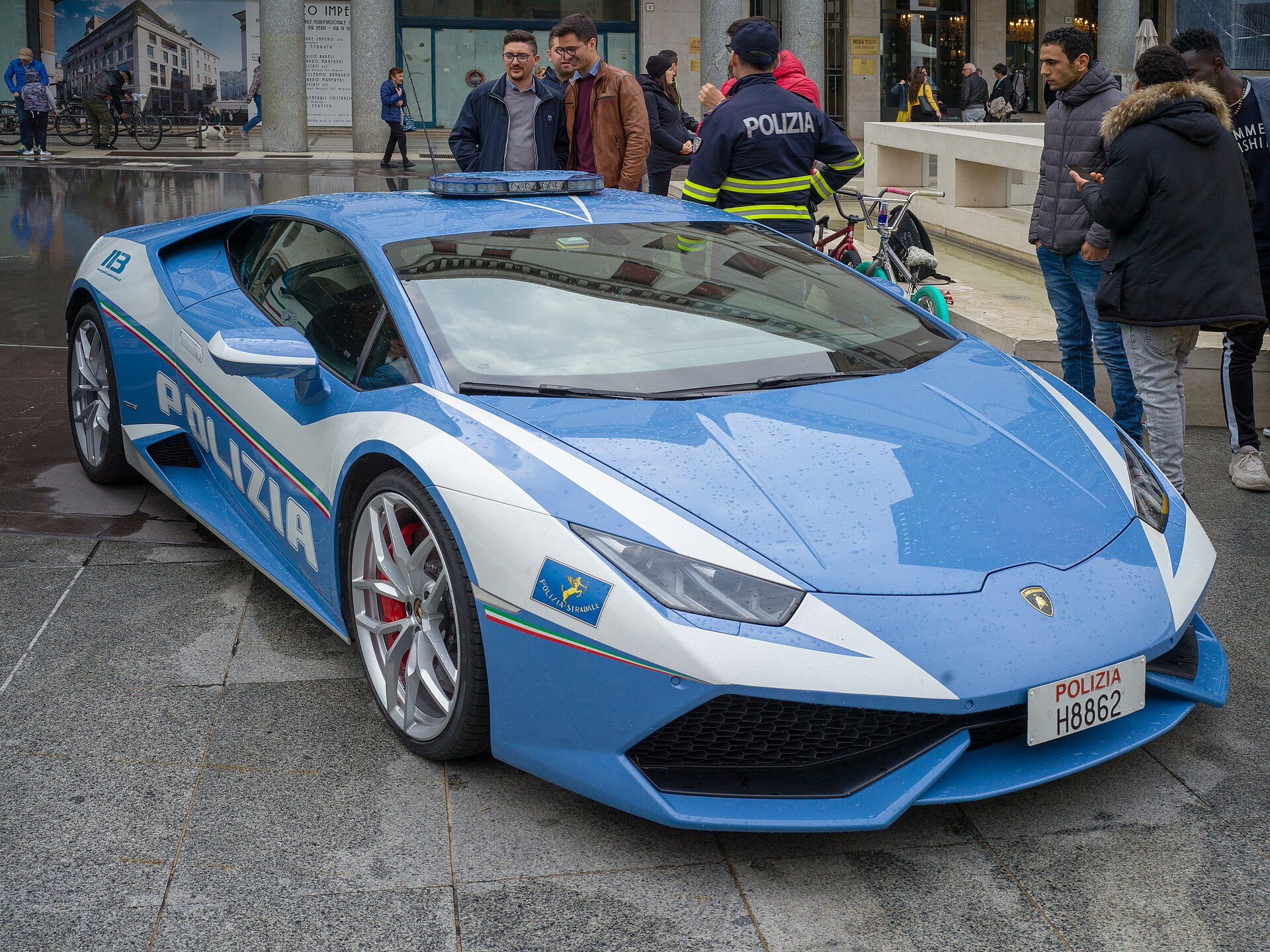
Lamborghini Huracán — Polizia di Stato
The Italian State Police currently operates two Lamborghini Huracán LP 610-4s — one of the most photographed police cars in the world. Both are finished in the Polizia’s distinctive blue and white livery with full light bars, police radio equipment, and — critically — a refrigerated compartment in the rear for transporting donor organs between hospitals at speed. This last detail is not a publicity stunt. Italy’s geography — long distances between major medical centres, congested motorways — creates real scenarios where organ transport time is critical. A Lamborghini Huracán can cover the distance between Rome and any major Italian city faster than any conventional ambulance vehicle, particularly on the Autostrada where its top speed of 325 km/h is not entirely theoretical. The cars are assigned to the Stradale — the motorway police division — and patrol the A1 motorway between Rome and Bologna. Officers assigned to the cars undergo specialist high-performance driving training before deployment. The previous generation Huracán replaced an earlier Lamborghini Gallardo LP 560-4 that served from 2004 until retirement. Before the Gallardo: a Lamborghini Diablo, acquired in 1993. Italy has been deploying Lamborghinis as police cars for over thirty years.
Ferrari FF — Polizia di Stato
Less well known than the Huracán but equally real: the Italian police operated a Ferrari FF — the four-wheel drive, four-seat grand tourer — as a patrol vehicle on northern Italian motorways. The FF’s all-wheel drive system made it genuinely useful in alpine conditions where a rear-wheel drive Lamborghini would be compromised. It was returned to Ferrari after its operational period ended. The partnership between the Polizia di Stato and Italy’s supercar manufacturers is ongoing — new deployments are announced periodically and generate international media coverage that neither party discourages.
Dubai — Where Excess Is a Policy
If Italy is the birthplace of the police supercar, Dubai is where the concept was taken to its logical extreme and then significantly beyond. The Dubai Police fleet is not a fleet in any conventional sense. It is a collection of the world’s most expensive and exclusive road cars, each bearing Dubai Police livery, each theoretically available for deployment — and each selected with an explicit understanding that the cars function as rolling advertisements for Dubai’s prosperity and ambition as much as law enforcement tools.
The Current Dubai Police Supercar Fleet
| Car | Power | Top Speed | Est. Value |
|---|---|---|---|
| Bugatti Veyron | 1,001hp | 407 km/h | $1.5 million |
| Lamborghini Aventador | 700hp | 350 km/h | $400,000 |
| Ferrari FF | 660hp | 335 km/h | $300,000 |
| McLaren MP4-12C | 616hp | 330 km/h | $250,000 |
| Aston Martin One-77 | 750hp | 354 km/h | $1.8 million |
| Bentley Continental GT | 567hp | 318 km/h | $200,000 |
| Mercedes SLS AMG | 571hp | 317 km/h | $200,000 |
| Porsche 918 Spyder | 887hp | 345 km/h | $900,000 |
| Lykan HyperSport | 770hp | 395 km/h | $3.4 million |
| Bugatti Chiron | 1,479hp | 420 km/h | $3 million |
The Lykan HyperSport deserves particular mention. Built by W Motors — a Lebanese-based manufacturer — it is one of only seven ever produced, with headlights embedded with actual diamonds and titanium blade LED strips. Dubai Police acquired one. The car famously appeared in Fast & Furious 7 — which was filmed partly in Dubai — crashing through three skyscrapers in a sequence that was entirely fictional but contributed enormously to the car’s global recognition. The Bugatti Veyron in the Dubai Police fleet is the first police Bugatti in history. Whether it has ever actually pursued a suspect is a question Dubai Police has declined to answer directly.
United Kingdom — Seized and Serving
The UK takes a different approach. Rather than purchasing supercars, British police forces occasionally seize high-value vehicles from criminals under the Proceeds of Crime Act and press them into operational service — combining punishment for the original owner with a practical asset for the force.
Seized Ferraris and Lamborghinis
Several UK police forces — including the Metropolitan Police and Greater Manchester Police — have operated seized supercars as patrol vehicles or for community engagement purposes. A Ferrari 360 Modena seized by the Metropolitan Police in the mid-2000s was used for several years before being auctioned.
The Lotus Evora — Purchased, Not Seized
Cambridgeshire Police purchased a Lotus Evora S for operational use in 2012 — a decision that generated significant public debate about appropriate use of police funding. The car was justified as a high-speed pursuit vehicle capable of matching modern performance cars on the region’s motorways. It was eventually sold after generating more media coverage than operational deployments.
Germany — Autobahn Logic
Germany’s Autobahn has sections with no speed limit — a fact that creates a genuine operational challenge for highway police. A patrol car that cannot match a modern sports car at high speed is limited in its pursuit capabilities. German traffic police have responded pragmatically.
Porsche 911 — Autobahnpolizei
Several German state police forces operate Porsche 911s for motorway patrol duties — specifically the Carrera 4S in all-wheel drive configuration for year-round usability. The 911’s combination of high top speed, all-weather capability, and Porsche’s legendary reliability makes it genuinely suitable for the Autobahn environment. Unlike the Dubai fleet or the Italian Lamborghinis, the German Porsche police cars are working vehicles first. They are equipped with full police electronics, marked in standard police livery, and deployed by officers with advanced pursuit driving qualifications.
Brabus-Modified Mercedes — Polizei Hamburg
Hamburg’s police force has operated Brabus-modified Mercedes patrol cars — tuned versions of the Mercedes E-Class and S-Class with enhanced performance for motorway operations. Not supercars in the traditional sense, but vehicles capable of sustained high-speed operation that standard patrol cars cannot match.
United States — Seized Exotics and Unexpected Deployments
American law enforcement has a long tradition of seizing exotic vehicles from drug traffickers and organised crime figures. The question of what to do with them generates interesting answers.
Sheriff’s Lamborghini Gallardo — Polk County, Florida
In 2008, the Polk County Sheriff’s Office in Florida acquired a Lamborghini Gallardo through asset forfeiture — seized from a convicted drug dealer. Rather than auctioning it immediately, Sheriff Grady Judd had the car painted in the department’s livery and used it for community relations and high-visibility patrol. The move generated international news coverage worth many times the car’s value in publicity for the department. The Gallardo was eventually sold at auction, with proceeds going to the department’s anti-drug programmes.
Dodge Viper — Texas Department of Public Safety
Several Texas law enforcement agencies have operated Dodge Vipers as patrol and pursuit vehicles — a choice driven partly by the car’s availability at relatively low cost (by supercar standards) and partly by the practical reality that Texas highways see genuine high-speed situations. The Viper’s 8.4L V10 provides the acceleration required. Its handling characteristics — demanding, unforgiving at the limit — required specialist training for assigned officers.
Japan — Nissan GT-R and Honda NSX
Japan’s highway police — the Metropolitan Expressway Traffic Police — have operated both the Nissan GT-R and the Honda NSX as patrol vehicles on Tokyo’s expressway network. Both choices reflect the specific operational environment: high-density urban expressways where acceleration and handling matter more than sustained top speed. The GT-R’s all-wheel drive system and launch control make it genuinely effective in the start-stop high-speed environments of Tokyo’s elevated expressways. Officers assigned to GT-R patrol duty undergo extended high-performance training at the Fuji Speedway circuit.
The Question Nobody Asks
Most coverage of police supercars focuses on the spectacle — the Lamborghini with a light bar, the Ferrari in blue livery, the Bugatti with police markings. The spectacle is real and it is considerable. But the more interesting question is what these cars reveal about the relationship between governments, manufacturers, and the public in different cultures. In Italy, the Lamborghini Polizia car is a source of genuine national pride — an expression of the country’s automotive heritage deployed in public service. In Dubai, the fleet is deliberate soft power — a statement about the emirate’s wealth and ambition directed at international visitors and media. In the UK, seized supercars are a form of public justice — criminals’ assets turned against them. In Germany, the Porsche is simply the most rational tool for a specific job. Same concept. Completely different meanings. The supercar as police vehicle is many things simultaneously: practical tool, publicity asset, cultural statement, and — occasionally — the fastest way to get a donor organ from one hospital to another.
Related reads: How Fast & Furious Elevated the Nissan Skyline… · Cinematic Cars That Defined Generations · Understanding the Green Hell