LaFerrari: Ferrari's Bold Shift to Hybrid Performance
Introduction — When Ferrari Had to Change For most of its history, Ferrari evolved by perfecting what it already knew how to do: better engines, lighter materials, more precise aerodynamics. Change was incremental, almost organic.
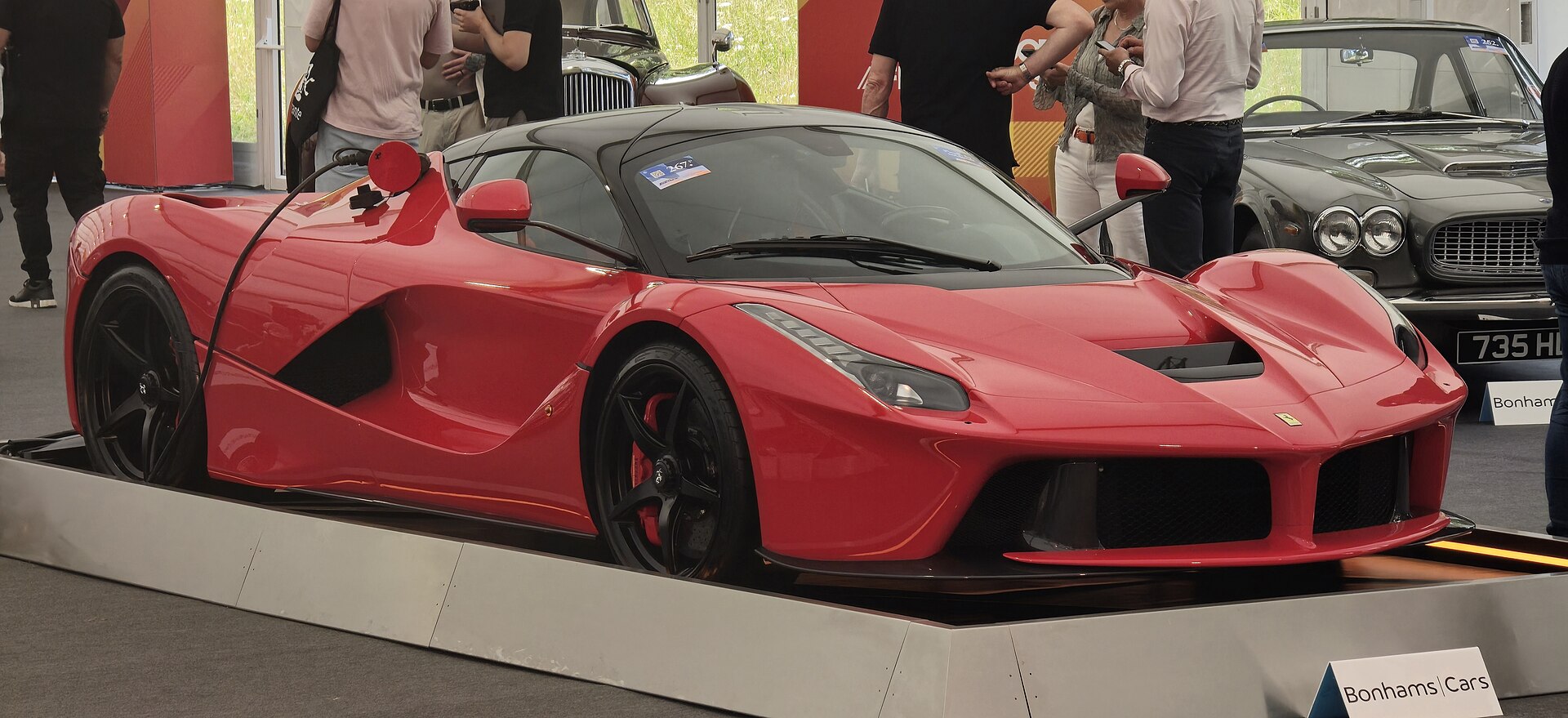
Introduction — When Ferrari Had to Change
For most of its history, Ferrari evolved by perfecting what it already knew how to do: better engines, lighter materials, more precise aerodynamics. Change was incremental, almost organic. LaFerrari was different. It was not an evolution. It was a rupture. For the first time, Ferrari openly acknowledged that mechanical excellence alone was no longer sufficient. The world of performance was changing: electrification, software, and integrated systems were becoming as important as pistons and crankshafts. LaFerrari was not built to chase competitors. It was built to ensure Ferrari could survive the future.
A Strategic Car, Not a Commercial One
LaFerrari was never intended to be a mass product or even a conventional flagship. It was conceived as a technological and philosophical pivot. Its role was to:
- Introduce hybrid systems into Ferrari’s identity
- Preserve emotional driving in a digital era
- Transfer Formula 1 technology to the road in a meaningful way
- Prepare Ferrari engineers for the next generation of performance
In this sense, LaFerrari is closer to a rolling laboratory than to a product. But unlike a laboratory, it had to feel alive.
Hybridization Without Losing the Soul
Ferrari’s approach to hybridization was radically different from that of most manufacturers. Hybrid systems are typically introduced for efficiency. Ferrari introduced them for intensity. The HY-KERS system recovers energy during braking and deceleration, stores it in a compact battery, and redeploys it instantly to supplement the engine. The effect is not visible. It is felt. Throttle response becomes immediate. Torque delivery becomes seamless. The car feels electrically enhanced but mechanically pure. The electric motor does not replace the V12. It protects it.
The V12 as Cultural Continuity
Ferrari could have used turbochargers. They chose not to. Turbocharging increases power easily, but it changes the character of the engine: response, sound, and emotional feedback are altered. Ferrari understood that LaFerrari could not afford to lose its voice. The naturally aspirated V12 remains the emotional anchor of the car. It ensures that no matter how advanced the systems become, the core experience remains unmistakably Ferrari.
Aerodynamics as Behavior, Not Shape
LaFerrari’s shape is elegant but restrained. That is because its aerodynamic sophistication is not in how it looks, but in how it behaves. Active aerodynamic elements constantly adjust to speed, braking, and cornering forces. The car is continuously reshaping its interaction with air to maximize grip, minimize drag, and manage cooling. LaFerrari does not simply cut through the air. It negotiates with it.
The Carbon Structure Beneath Everything
The carbon fiber monocoque is not just a structure. It is the foundation that makes everything else possible. Developed using Ferrari’s Formula 1 composite expertise, it provides extreme rigidity and low weight, allowing the suspension, aerodynamics, and powertrain to work with precision. Without this rigidity, the car would be chaotic. With it, the car becomes coherent.
Software as the New Mechanical Layer
LaFerrari is Ferrari’s first truly software-defined performance car. Software governs:
- Power distribution
- Energy recovery
- Torque blending
- Traction control
- Aerodynamic balance
The driver is no longer commanding a machine. The driver is cooperating with a system. This changes the nature of performance itself. Speed becomes orchestration.
Cultural Meaning
LaFerrari arrived at a moment when the automotive world was losing its analog purity. It reassured Ferrari enthusiasts that emotion would not disappear. It showed the industry that tradition and innovation are not opposites. It became a bridge between eras.
Conclusion — Ferrari Teaches Itself How to Evolve
LaFerrari is not Ferrari’s fastest car. It is Ferrari’s most self-aware car. It exists not to dominate rivals, but to teach Ferrari how to remain Ferrari in a changing world. That is why LaFerrari matters. Not as a machine. But as a decision.
Technical Specifications — Ferrari LaFerrari
Ferrari LaFerrari: manufacturer Ferrari; production years 2013–2016 (coupé) and 2016–2018 (Aperta); production units 499 coupés and 210 Apertas; layout mid-engine, rear-wheel drive; engine 6.3-liter naturally aspirated V12 producing 800 hp at 9,250 rpm combined with a 120 kW electric motor for a total system output of 963 hp and approx. 900 Nm of combined torque; 0–100 km/h in approx. 2.6 s; 0–200 km/h in approx. 6.9 s; top speed over 350 km/h; transmission 7-speed dual-clutch automatic; battery lithium-ion HY-KERS system; chassis carbon fiber monocoque developed with Formula 1 technology; kerb weight approx. 1,585 kg; suspension double wishbone front and rear with adaptive dampers; brakes carbon-ceramic discs with 6-piston front and 4-piston rear calipers; aerodynamics active front flaps and adaptive rear spoiler.
Related reads: Ferrari SF90 · How LaFerrari, P1 & 918 Spyder Revolutionized… · Ferrari Enzo