Ferrari F50: The Ultimate Road-legal Racing Machine
Introduction — When Racing Became Road Legal The Ferrari F50 is often misunderstood. It is not a successor to the F40 in spirit — it is its opposite.
Introduction — When Racing Became Road Legal
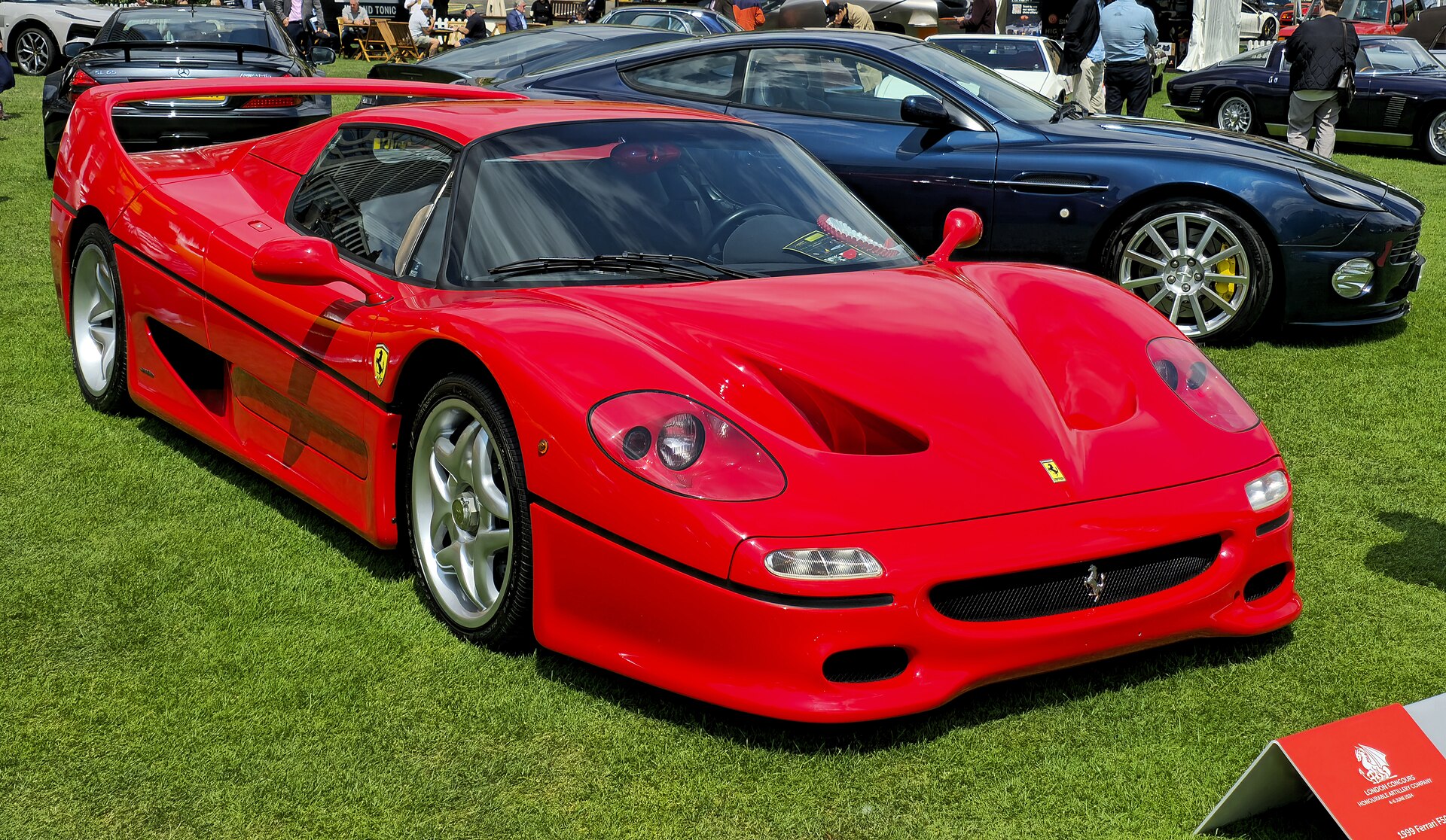
The Ferrari F50 is often misunderstood. It is not a successor to the F40 in spirit — it is its opposite. Where the F40 was brutal and mechanical, the F50 is precise, engineered, and deeply connected to motorsport. It is essentially a Formula 1 car disguised as a road vehicle. Ferrari did not try to build a faster supercar. They tried to build a road-legal racing machine. And that is exactly what the F50 is.
1. A Naturally Aspirated Formula 1 Engine
At the heart of the F50 lies a 4.7-liter naturally aspirated V12 derived directly from Ferrari’s 1990 F1 engine architecture. It is:
- Naturally aspirated
- Extremely high-revving
- Structurally integrated into the chassis
This is not a car with an engine. It is an engine with a car attached.
2. Chassis as a Racing Structure
The F50 uses:
- A carbon fiber monocoque
- The engine as a stressed structural member
- Pushrod suspension derived from racing
This architecture is pure motorsport thinking. Weight, stiffness, and feedback were prioritized over comfort and isolation.
3. Aerodynamics Without Electronics
The F50 relies on:
- Fixed aerodynamic surfaces
- Underbody airflow management
- Passive downforce
There are no active aero systems. The car is shaped by airflow, not software.
4. A Pure Driving Experience
The F50 has:
- No traction control
- No stability control
- No power steering
- No electronic intervention
It is a direct communication channel between driver and physics. The car does not help you. It tells you.
5. Why the F50 Was Ahead of Its Time
The F50 anticipated trends that would dominate decades later:
- Lightweight construction
- Structural integration
- Track-focused engineering
- Experience over luxury
It was not designed to impress. It was designed to perform.
Conclusion — Engineering Without Compromise
The Ferrari F50 is not beautiful in the traditional sense. It is honest. It exposes its engineering rather than hiding it. It is a declaration that performance is not about spectacle — it is about structure, feedback, and intent. The F50 is not a supercar. It is a race car that tolerates traffic lights.
Ferrari F50 — Technical Specifications
Ferrari F50: manufacturer Ferrari; production years 1995–1997; production units 349; layout mid-engine, rear-wheel drive; engine 4.7-liter naturally aspirated V12 derived from Formula 1 producing 520 hp at 8,500 rpm and 471 Nm of torque, 0–100 km/h in approx. 3.9 s, 0–200 km/h in approx. 11.0 s, top speed 325 km/h; transmission 6-speed manual; chassis carbon fiber monocoque with the engine as a stressed structural member; kerb weight approx. 1,230 kg; suspension double wishbone front and rear with pushrod actuated dampers; brakes ventilated discs with no traction control or stability systems; aerodynamics fixed aerodynamic surfaces with underbody airflow management, no active aero.
Related reads: Ferrari Enzo · Ferrari F40 · Ferrari 488 Pista