Why the Aston Martin Valkyrie Redefines Road-Legal Cars
The Aston Martin Valkyrie isn’t “inspired by Formula 1.” It’s closer to the opposite: it’s what happens when you start with race-car thinking aero, packaging, stiffness, power density, then fight reality until the result becomes b…
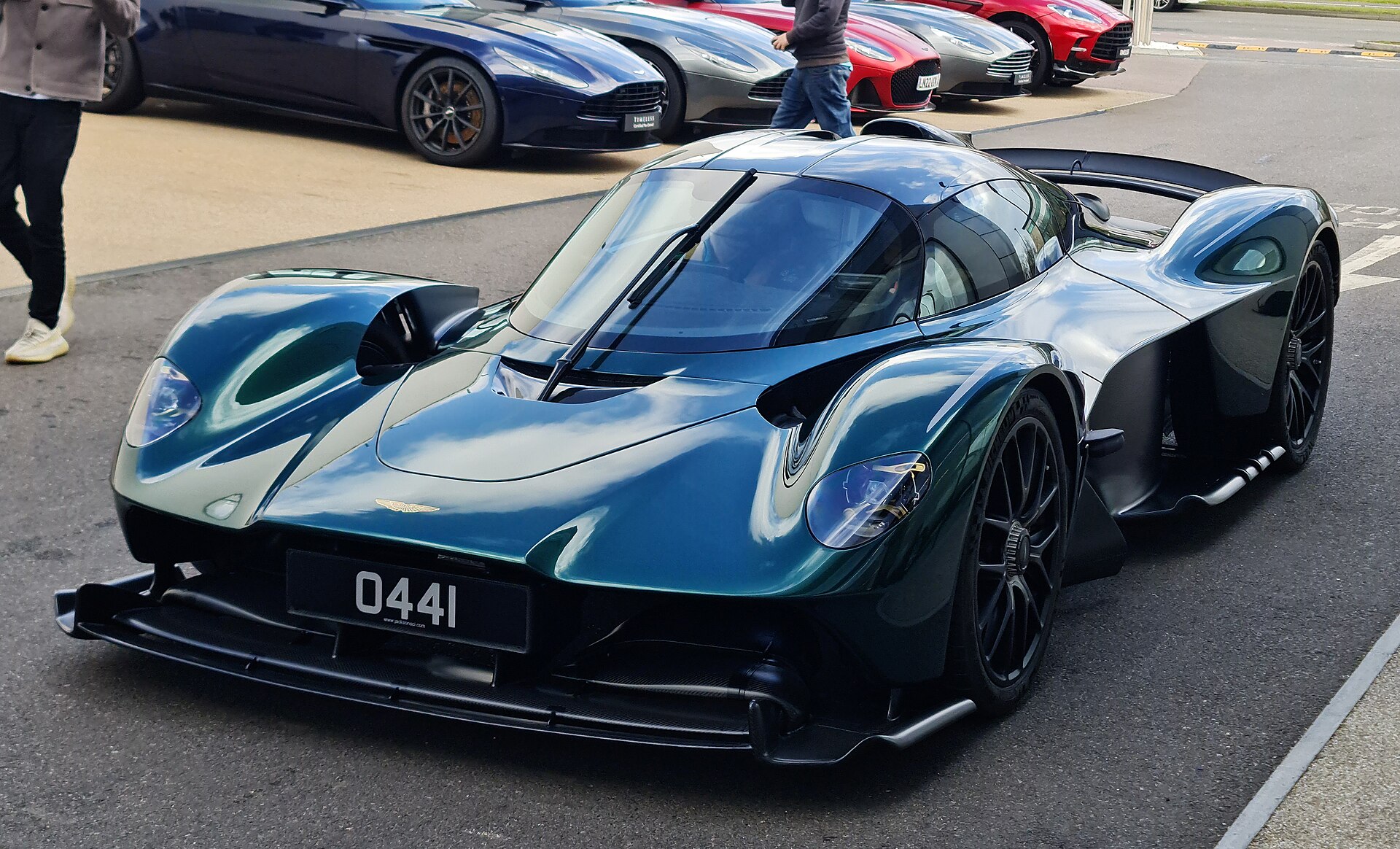
The Aston Martin Valkyrie isn’t “inspired by Formula 1.” It’s closer to the opposite: it’s what happens when you start with race-car thinking (aero, packaging, stiffness, power density), then fight reality until the result becomes barely road-legal.
From day one, the project was shaped by a rare collaboration between Aston Martin Lagonda and Red Bull Advanced Technologies, with the aerodynamic philosophy led by Adrian Newey. The goal wasn’t comfort, or even “hypercar theatre”—it was a road car that behaves like a single integrated performance system, where powertrain, aero, suspension control and chassis structure all serve one purpose: speed with stability.
The heart of the Valkyrie: a 6.5L naturally aspirated V12 that revs to 11,100 rpm
At the center is a 6.5-litre 65° V12 developed with Cosworth—a modern masterpiece built to deliver huge power without turbocharging, and to rev like a 1990s-era F1 engine.
Official engine highlights include:
- 6.5L NA V12
- 1,000 bhp at 10,500 rpm (engine alone)
- 11,100 rpm maximum
- Engine used as a fully stressed structural element
- Engine weight cited as 206 kg in Aston Martin’s own release
This is the Valkyrie’s “signature.” It’s not just loud—it’s high frequency, mechanical, and borderline unreal for a road car.
Hybrid system: built for performance, not eco points
Aston Martin confirmed the full hybrid system figures in an official powertrain announcement:
- Total maximum power: 1,160 bhp @ 10,500 rpm
- Peak combined torque: 900 Nm @ 6,000 rpm
- Hybrid contribution: +160 bhp and +280 Nm
- Hybrid partners mentioned: Rimac Automobili (battery system) and Integral Powertrain (e-motor)
The point of this hybridization isn’t smoothness. It’s response, torque fill, and delivering the kind of acceleration and mid-corner adjustability you normally associate with racing powertrains.
100% carbon structure and why it matters
Aston Martin states something that still reads like science fiction:
“There is not one single steel component in structure. It is 100% carbon fibre…”
That’s not marketing fluff—it’s a design decision that supports the Valkyrie’s whole concept: extreme stiffness, low mass, and very precise control of suspension geometry under load.
Aero and hydraulics: why the Valkyrie “loads up” like a race car
Valkyrie’s body isn’t sculpture—it’s airflow management. The official model page emphasizes the open underfloor, downforce-driven body shape, and an active aero/hydraulic control strategy running thousands of adjustments per second.
Aston Martin also publishes eye-watering grip figures on the same page:
- ~3.3g lateral g-force
- ~1.9g braking force
- Suspension/aero described as “F1 derived double wishbone” with multiple control strategies
That’s why the Valkyrie is so different from “big power” hypercars: at speed, it’s designed to feel more stable, not more nervous.
Real-world proof: the Top Gear lap record
In March 2025, outlets reported that the Valkyrie became the fastest road-legal car around the famous Dunsfold Aerodrome test track (the home of Top Gear), with The Stig setting a reported 1:09.6 lap time—enough to top the leaderboard at the time.
Whether you care about lap times or not, that record aligns perfectly with the Valkyrie’s mission: aero + chassis + response, not just horsepower.
Production and rarity
Valkyrie production ran from late 2021 into 2024, with total numbers across variants often cited as limited—enough to keep it mythical but not invisible. (Commonly cited figures are 150 Coupés, 85 Spiders, 40 AMR Pro.)
Technical data snapshot
Here’s a clean “at-a-glance” spec pack using Aston Martin’s published numbers:
Powertrain
- Engine: 6.5L naturally aspirated V12
- Max engine speed: 11,100 rpm
- Engine output (ICE): 1,000 bhp @ 10,500 rpm
- Hybrid system total: 1,160 bhp @ 10,500 rpm
- Combined torque: 900 Nm @ 6,000 rpm
Chassis / structure
- Structure: 100% carbon fibre (no steel in structure)
- Officially stated grip benchmarks: ~3.3g lateral, ~1.9g braking
Brakes (from Aston Martin spec list on the model page)
- Front discs: 420 mm CCM-R
- Rear discs: 385 mm CCM-R
Note on top speed: Aston Martin’s public spec page shows “Top Speed mph” as a field, but the numeric value isn’t reliably visible in the static page text extract. I’m intentionally not stating an “official” top speed here unless it’s explicitly published in an official spec table you can view.
Why Valkyrie is a turning point
A lot of hypercars feel like a greatest-hits album: big power, big price, big presence.
Valkyrie feels like a technical manifesto—an attempt to compress race-car logic into a road-car envelope without softening the edges. That’s why people talk about it as if it’s from the future: the engineering priorities are simply different from almost everything else on the road.
If you had one weekend—mountain roads + one full track day—would you take the Valkyrie Coupé, the open-top Spider, or the track-only AMR Pro? Comment your pick and tell me why.
And if you want more articles like this on SupercarsPassion (deep engineering + clean spec sheets + real-world proof), bookmark the site and share this post with a friend who thinks “hypercars are all the same now.”
Related reads: Aston Martin Valhalla · Aston Martin History · F1 Tech’s Impact on Hypercar Performance