Ferrari vs Lamborghini: The V12 Rivalry Unleashed
The Enzo–Ferruccio feud—and how their V12 engines evolved into two totally different legends Every great rivalry needs an origin story, and Ferrari vs Lamborghini has one of the best: a proud tractor magnate, a temperamental maest…
The Enzo–Ferruccio feud—and how their V12 engines evolved into two totally different legends
Every great rivalry needs an origin story, and Ferrari vs Lamborghini has one of the best: a proud tractor magnate, a temperamental maestro from Maranello, and a clutch complaint that allegedly turned into an insult—followed by one of the boldest “fine, I’ll do it myself” moments in automotive history.
But here’s the twist: the myth matters because it aligns perfectly with the engineering reality that came after it. Ferrari doubled down on racing-bred V12 tradition; Lamborghini—born from a road-car-only philosophy—built a V12 that was smoother, more civilized, and later became the soundtrack of the wildest wedge-shaped supercars ever made.
Let’s tell the story and track the real technical evolution of both V12 bloodlines.
1) The argument that started it all (and why the details vary)
The most repeated version goes like this: Ferruccio Lamborghini, already wealthy from tractors, owned a Ferrari (often cited as a 250 GT). He wasn’t happy with the clutch and went to Maranello to complain directly to Enzo Ferrari. The response—depending on the telling—was dismissive and personal, implying Ferruccio should stick to tractors. Soon after, Ferruccio decided to build a GT car that could beat Ferrari on the road.
Two important notes for credibility:
- It’s widely treated as “true in essence, fuzzy in wording.” The exact quote is hard to verify decades later, but the outcome is not disputed: Lamborghini entered the sports car world in 1963–64 and immediately targeted Ferrari’s territory.
- The “tractor clutch” angle is also part of the folklore, and major outlets still reference it as the spark.
Whether the insult was word-for-word accurate or not, the rivalry stuck because it fits the personalities: Ferrari the racing purist, Lamborghini the industrial perfectionist who wanted a refined GT that didn’t punish its owner.
2) Ferrari’s V12: born in racing, refined on the road
Ferrari’s identity is inseparable from the V12. The first Ferrari-badged car, the 125 S, launched in 1947 with a 1.5-liter V12 designed by Gioacchino Colombo (with contributions from Busso and Bazzi).
The Colombo era: small displacement, big ambition
The classic Colombo concept was a compact 60° V12 architecture that Ferrari stretched and evolved for decades. Wikipedia’s technical overview tracks the Colombo family running from 1947 to 1988, always anchored by the same fundamental layout idea.
Why it mattered: Ferrari’s early V12s weren’t just “engines,” they were platforms—built to scale, rev, and race.
The Lampredi era: bigger displacement for bigger battles
When Ferrari needed more torque and displacement for top-level competition, Aurelio Lampredi developed larger V12s—famously nearing 5.0 liters in cars like the 375 Plus. Ferrari’s own page describes the 375 Plus as using a Lampredi-developed V12 “of nearly five litres.”
Goodwood also outlines the Lampredi V12’s role as the large-capacity counterpart to early Colombo racing units.
Ferrari’s V12 philosophy, in one line: motorsport DNA first, road refinement second.
The modern Ferrari V12: the 65° F140 family
Fast-forward to modern times: Ferrari’s magazine notes that the latest V12 family, the F140, debuted in the Enzo in 2002.
Ferrari’s 599 GTB Fiorano page also specifies a 65° V12 architecture, showing how Ferrari’s modern V12 became a new engineering chapter while keeping the “high-rev, naturally aspirated” soul.
3) Lamborghini’s V12: engineered to beat Ferrari on the road, not on the grid
Here’s the key difference: Ferruccio famously wasn’t interested in racing—he wanted a road car that felt fast, solid, and reliable.
The original Lamborghini V12 (1963): Bizzarrini’s blueprint
Lamborghini’s official history states the 350 GT “paved the way” with a 60° V12, a 3.5-liter version featuring double overhead camshafts and six carburetors, first designed in 1963 by Giotto Bizzarrini—originally with competition intent.
This is the most important technical mic-drop in the whole rivalry:
- Lamborghini’s first serious sports car arrived with a purpose-built V12 from day one, not a borrowed engine, not a “good enough” unit.
Lamborghini’s V12 philosophy, in one line: smooth grand-touring performance first, then escalating madness.
From GT elegance to mid-engine revolution
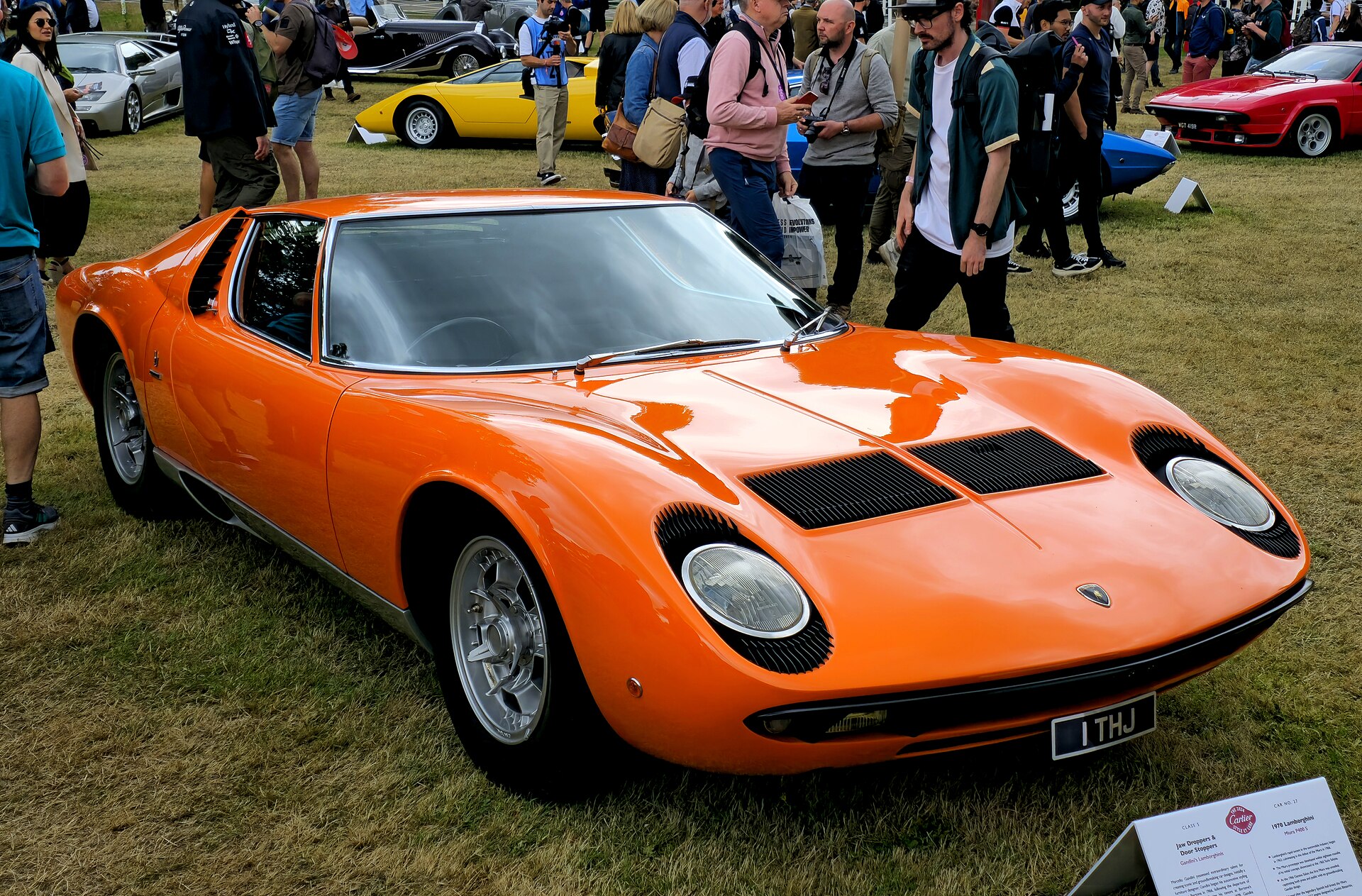
Once Lamborghini moved the V12 behind the driver (the era that leads to icons like the Miura and the wedge dynasty), the same fundamental V12 concept kept evolving in displacement and character—becoming more extreme as the brand’s design language got more radical.
Lamborghini’s own milestones page notes that with the Diablo, the V12 reached 5.7 liters and exceeded 320 km/h.
The modern twist: Revuelto and the electrified V12 future
In today’s era, Lamborghini’s flagship V12 doesn’t disappear—it hybridizes. The Revuelto pairs a new 12-cylinder engine with three electric motors for a total of 1015 CV, explicitly framing hybridization as a performance enhancer.
4) The rivalry explained through engineering personality
Ferrari’s V12 feel
- Built from racing tradition (125 S origins, decades of evolution).
- Typically defined by sharp throttle response, high rpm character, and the sense that the engine is the “main event.”
Lamborghini’s V12 feel
- Born from a road-car brief: fast, refined, and impressive without punishment.
- Later evolved into theatrical excess: dramatic packaging, outrageous styling, and a V12 that became a brand signature.
In other words: Ferrari made V12s to win; Lamborghini made V12s to conquer the senses.
5) Why this story still works (and always will)
Because it’s not just gossip—it’s a parable about two ways to build greatness:
- Craft a legend from racing (Ferrari)
- Challenge a legend through product obsession (Lamborghini)
And the V12 is the perfect storytelling tool because it’s tangible: layout angles, displacement growth, induction changes, and the sound that never lies.
If you had to pick one V12 philosophy for your dream garage, which do you choose—and why?
Lamborghini: road-first refinement turned into theatrical power
Ferrari: racing lineage, screaming precision
Related reads: Lamborghini Miura · How LaFerrari, P1 & 918 Spyder Revolutionized… · Lamborghini Veneno